Indoor Air Quality (IAQ) refers to the air quality within and around buildings and structures, especially as it relates to the health and comfort of building occupants. Understanding and controlling common pollutants indoors can help reduce risk of indoor health concerns. UAE’s Mandatory Indoor Air Quality Law aims to achieve clean air standards on 90% of the days by 2030, thus helping enhance public health and environmental sustainability. The strategy provides for sector-specific targets and initiatives to reduce fine particulate matter.
UAE have poor air quality because Dubai’s air pollution is fueled by a combination of natural and human-driven factors. Frequent desert dust storms and blowing sand, aided by its location in an arid region, are primary contributors to elevated particulate levels.
UAE’s recent indoor air quality (IAQ) regulations, primarily enforced by Dubai Municipality and referenced in Law No. (5) of 2025 Article 33, mandate property owners to maintain healthy indoor environments in public buildings like offices, schools, and hospitals. These rules emphasize annual testing, proper ventilation, and pollutant limits to protect occupant health amid urban growth.
Compliance involves certified monitoring and remediation to avoid fines or restrictions.
Key Requirements
Property owners must perform annual professional IAQ testing, keep detailed records, and fix issues promptly, including HVAC cleaning and filtration upgrades. Dubai Municipality standards limit formaldehyde to under 0.08 ppm, TVOC (Total Volatile Organic Compounds) to below 300 μg/m³, and suspended particulates to less than 150 μg/m³ over 8-hour monitoring.
Impacts on Offices
Offices require continuous IAQ sensors, multilayer filtration and humidity control between 40-60% to boost productivity and meet Dubai Health Authority rules. Non-compliance risks penalties, operational disruptions, and health claims from poor air linked to respiratory issues. Regular maintenance prevents pollutant buildup in high-occupancy spaces.
Impacts on Schools
Schools and nurseries face strict enforcement after studies showed exceedances in CO₂, TVOC, formaldehyde, and particulates, prompting ventilation upgrades and air purifiers. Dubai Municipality evaluated 70 institutions, setting limits to curb Sick Building Syndrome symptoms like eye irritation and drowsiness in children. Real-time monitoring and ERV systems are recommended for compliance.
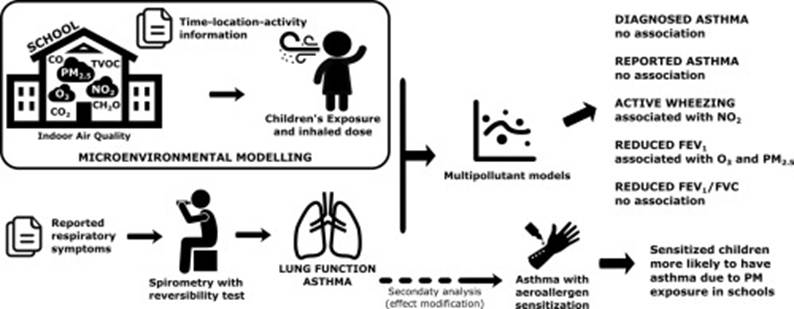
Image Source: sciencedirect
Impacts on Hospitals
Hospitals prioritize infection control through sensitive IAQ testing for airborne contaminants, aligning with Dubai Health Authority standards to minimize hospital-acquired infections. Enhanced filtration and ventilation reduce microbial risks in patient areas. Mandatory compliance ensures staff and patient safety, with immediate remediation required.

Specified Pollutants and Limits for Offices Schools & Hospitals in The Law
UAE’s indoor air quality regulations, outlined in Dubai Municipality’s Technical Guidelines (DM-HSD-GU119-IAQ) and tied to Federal Law No. (5) of 2025 Article 33, specify pollutant limits for public buildings including offices, schools, and hospitals.
Specified Pollutants and Limits
Core parameters include chemical, particulate, and biological contaminants, with no sector-specific variations noted for offices, schools, or hospitals.
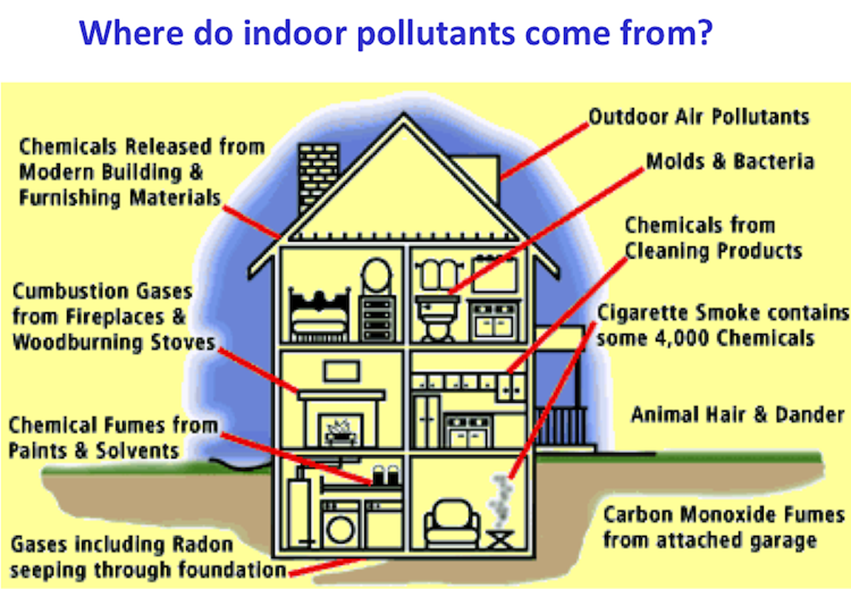
Image Source: apsi
| Pollutant | Limit | Measurement Basis |
| Formaldehyde (HCHO) | < 0.08 ppm | 8-hour average |
| Total Volatile Organic Compounds (TVOC) | < 300 μg/m³ | 8-hour average |
| Total Suspended Particulates (TSP) | < 150 μg/m³ | 8-hour average |
| Carbon Dioxide (CO₂) | < 1000 ppm | Continuous monitoring |
| Relative Humidity | 40-60% | Continuous |
| Temperature | 22-26°C | Continuous |
Compliances
Exceedances trigger remediation like HVAC upgrades or air purifiers, with real-time sensors mandatory in high-occupancy areas. Schools emphasize CO₂ and particulates due to child vulnerability, while hospitals add microbial testing for infection control. Offices focus on TVOC from furnishings to support productivity.
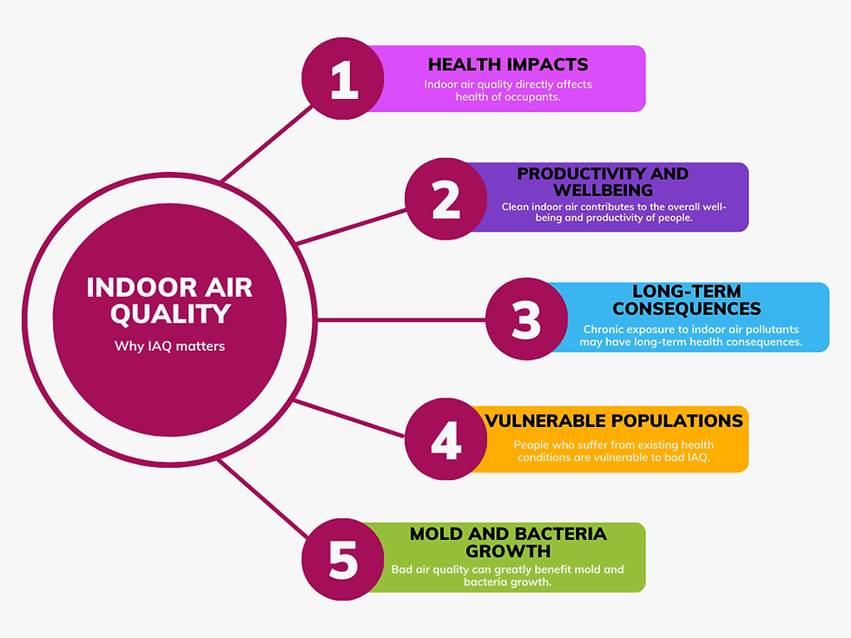
Image Source: ubreathe
Annual Testing and Reporting Requirements for Property Owners
UAE’s indoor air quality law, under Dubai Municipality’s Technical Guidelines (DM-HSD-GU119-IAQ) and Federal Law No. (5) of 2025 Article 33, requires property owners of public buildings like offices, schools, and hospitals to conduct annual IAQ testing and maintain compliance records. Certified professionals perform comprehensive assessments using calibrated equipment, with reports submitted to authorities upon request. Non-compliance leads to fines, operational halts, or mandatory remediation.
Testing Requirements
Owners must test key pollutants annually, including formaldehyde, TVOC, particulates, CO₂, humidity, and temperature, over 8-hour averages in occupied zones. Sampling follows WHO/ASHRAE protocols at representative locations like workstations or classrooms, with HVAC systems inspected for filtration and ventilation efficacy. Biological contaminants like mold require visual and swab tests in high-risk areas.
Reporting and Documentation
Owners keep detailed records of tests, maintenance logs, and remediation actions for at least 5 years, available for Dubai Municipality inspections.
Positive reports earn IAQ certification badges for display, while exceedances demand corrective plans within 30 days. Digital submission via municipality portals is encouraged for high-occupancy facilities.
Entities Responsible for Enforcement and Penalties Under the Law
Dubai Municipality serves as the primary enforcer for indoor air quality compliance in public buildings like offices, schools, and hospitals under Technical Guidelines DM-HSD-GU119-IAQ and Federal Law No. (5) of 2025 Article 33. The Ministry of Climate Change and Environment (MOCCAE) provides national oversight via the Air Quality Agenda 2031, while emirate-level agencies like Abu Dhabi Environment Agency (EAD) handle local enforcement and inspections. Dubai Health Authority supports in healthcare facilities.
Enforcement Mechanisms
Municipalities conduct random inspections, review submitted records, and respond to complaints with on-site testing using calibrated equipment. Exceedances prompt violation notices, requiring remediation plans within 30 days; repeated issues lead to operational suspensions or closures. Certified third-party auditors assist in verification.
HVAC Systems Upgrade to Meet Dubai Municipality IAQ Guidelines
Documentation of upgrades supports compliance reporting.HVAC systems must be upgraded to meet Dubai Municipality’s IAQ guidelines (DM-HSD-GU119-IAQ) by incorporating high-efficiency filtration, enhanced ventilation, and continuous monitoring to ensure pollutant levels stay within specified limits. Upgrades focus on multi-stage filtration, energy recovery ventilation (ERV), and regular maintenance to support annual compliance testing in offices, schools, and hospitals.
Filtration Upgrades
Install multi-layer filters starting with pre-filters (G4), fine filters (F7-F9), and HEPA (H13-H14) for capturing 99.97% of particulates down to 0.3 μm, reducing TSP below 150 μg/m³. Add activated carbon filters for VOC and formaldehyde adsorption, with quarterly replacements based on pressure drop monitoring. UVGI lamps or photocatalytic oxidizers target biological contaminants like mold spores.
Ventilation Enhancements
Increase outdoor air intake to achieve 6-10 air changes per hour (ACH) via demand-controlled ventilation (DCV) sensors for CO₂ and humidity (40-60%). Integrate ERV or HRV systems to precondition fresh air, maintaining temperature at 22-26°C while minimizing energy loss. Duct cleaning every 6-12 months prevents microbial buildup.
Monitoring and Controls
Deploy real-time IAQ sensors for CO₂, TVOC, PM2.5, humidity, and temperature, integrated with BMS for automated adjustments and alerts. Annual performance verification by certified technicians ensures MERV 13+ efficiency and airflow rates meet ASHRAE 62.1 standards.
Documentation Needed to Prove Compliance During Inspections
Property owners must maintain comprehensive documentation to demonstrate IAQ compliance during Dubai Municipality inspections under Technical Guidelines DM-HSD-GU119-IAQ.
Records prove adherence to annual testing, maintenance, and pollutant limits, with non-availability risking fines or certification denial. All documents should be organized in a dedicated register, available on-site or digitally via municipality portals.
Required Documents
- Annual IAQ test reports from DM-accredited labs, showing pollutant levels (e.g., formaldehyde <0.08 ppm, TVOC <300 μg/m³) with sampling details and 8-hour averages.
- Equipment calibration certificates (initial and annual) from DM-approved facilities, stored for verification.
- HVAC maintenance logs, including inspection/cleaning records, filter replacements, and performance verification per approved specs.
- Remediation plans and completion certificates for any exceedances, with timelines.
- Real-time monitoring data logs from IAQ sensors , integrated with BMS reports.
- IAQ compliance certificates or badges issued by DM, plus occupancy and ventilation design drawings.
Agency Authorized to Handle Inspections and Issuing Fines Under the Law
Dubai Municipality’s Public Health and Safety Department and Environment Department handle inspections and issue fines for indoor air quality non-compliance under Technical Guidelines DM-HSD-GU119-IAQ and Federal Law No. (5) of 2025 Article 33.
They conduct audits, verify records, and perform on-site testing in public buildings like offices, schools, and hospitals.
Inspection Process
Inspections involve reviewing:
- the special register of test reports
- calibration certificates
- maintenance logs during random or complaint-driven visits.
- HVAC cleanliness, sensor data
- pollutant levels against limits
“Non-conformities result in immediate notices requiring remediation within 30 days.”
Fine Issuance
Dubai Municipality enforces indoor air quality regulations under Technical Guidelines DM-HSD-GU119-IAQ and Federal Law No. (5) of 2025 Article 33, with penalties scaled by violation severity.
Fines start at AED 10,000-50,000 per initial violation, escalating to AED 100,000+ for non-remediation, with potential license revocation or legal action under public health laws. EAD examples include temporary shutdowns for VOC exceedances, emphasizing health and environmental protection. AED 100,000+ or operational suspensions for repeats, with authority to revoke IAQ certificates. Compliance certification mitigates risks.
Dubai Health Authority assists in healthcare facilities, while MOCCAE oversees national alignment. Compliance renewal depends on passing these checks.
Additional Sanctions
Severe cases trigger operational suspensions, license revocations, or temporary closures until compliance, plus daily fines during non-compliance periods. Legal action under public health laws may add imprisonment for responsible parties, alongside certificate denial. Compliance reinstatement requires re-inspection and fees.
Responsibilities of Local Versus Federal Authorities for Enforcement
Local Responsibilities
Dubai Municipality’s Environment and Public Health Departments conduct on-site testing, review documentation and issue penalties for non-compliance. Dubai Health Authority (DHA) enforces in hospitals and schools, approving plans during construction and operations.
Federal Responsibilities
The Ministry of Climate Change and Environment (MOCCAE) sets overarching policies via the National Air Quality Agenda 2031, coordinates cross-emirate standards, and monitors broader environmental impacts without direct local inspections. Federal laws like No. (5) of 2025 enable uniform pollutant limits, with locals adapting enforcement.
Summary
In 2025, the UAE is transitioning from voluntary sustainability initiatives to enforceable mandates following the enactment of the UAE Climate Decree 2025 which came into force on May 30, 2025. This law, along with local regulations from the Dubai Municipality (DM) and Abu Dhabi Public Health Centre (ADPHC), makes indoor air quality (IAQ) a mandatory compliance requirement for offices, schools, and hospitals.
Join us and unlock a world of online courses in Mechanical Engineering, Occupational Health and Safety, Fire Safety, and Environment and Sustainability. Propel your career to new heights.
Propel your career to new heights.
Connect now and take the next step toward professional excellence!
+91 7569034271
Let’s connect together on: Facebook, YouTube, LinkedIn, and Instagram.