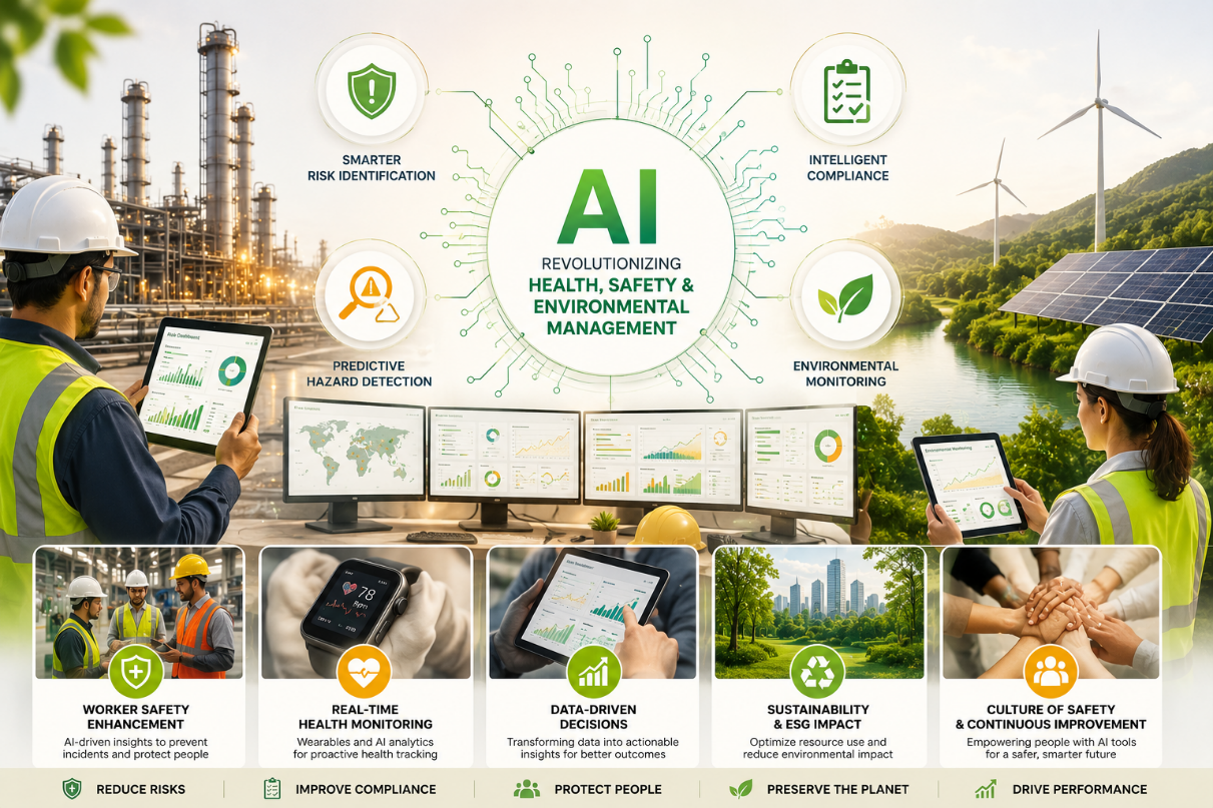
Artificial intelligence is changing health, safety, and environmental management from a reactive function into a proactive, data-driven discipline. Traditional HSE programs often depend on people noticing issues, logging them correctly, and reviewing them later. AI adds speed and scale by turning observations, incident records, audit findings, sensor data, and camera footage into usable insights.
Instead of relying only on manual inspections and delayed reporting, AI helps teams spot risks earlier, improve compliance, and act faster across operations. That means organizations can identify hazards, patterns, and control gaps before they become incidents. The greatest value of AI in HSE is that it helps teams move from reactive to proactive management. Instead of spending so much time documenting problems after they happen, organizations can use AI to spot patterns, prioritize action, and improve performance continuously.
How AI Is Reshaping These Three Core Areas of HSE
1. Health: Protecting Workers and Improving Wellness
AI ensures that occupational health goes beyond basic first aid by continuously monitoring both physical and mental well-being.
- Wearable Technology: Workers wear smart that track heart rate, body temperature, and fatigue levels in real-time. If the AI detects that a worker is getting too tired or stressed, it alerts a supervisor to force a break.
- Health Analytics: AI processes these health metrics to find early signs of illness or muscle and bone strains before they become serious medical leaves.
2. Safety: Preventing Accidents Before They Happen
Instead of waiting for an accident to occur, safety teams use AI to spot risks hidden in daily operations.
- Smart Cameras (Computer Vision): AI can analyze video feeds of factory floors or construction sites. It instantly spots if someone is missing their Personal Protective Equipment or if they are walking into a restricted, dangerous area.
- Predictive Maintenance: Machines often fail and cause injuries. AI continuously checks equipment logs, vibration, and temperature to predict when a part will break so it can be fixed safely beforehand.
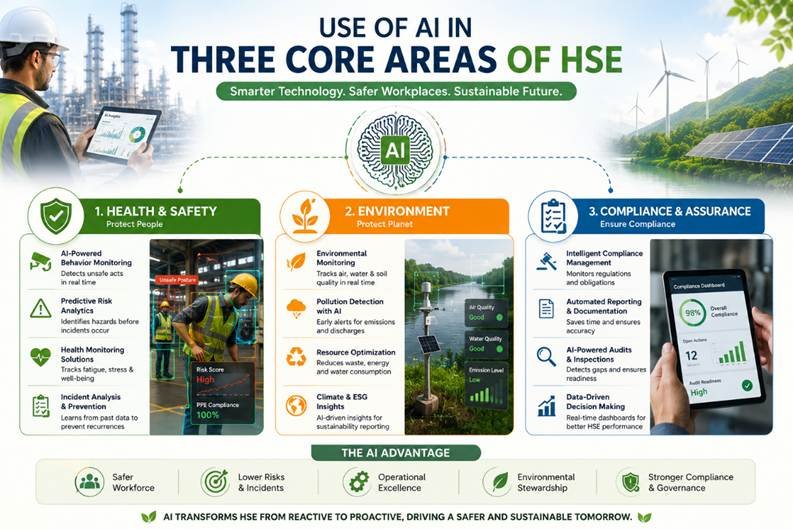
3. Environment: Reducing Harm to the Planet
AI helps companies track and shrink their environmental footprints, comply with laws, and avoid costly spills or emissions.
- Resource Optimization: AI analyzes a facility’s energy and water use to find ways to waste less and lower overall carbon emissions.
- Pollution Tracking: Sensors combined with AI can monitor air quality and water runoff, detecting illegal leaks or chemical spills much faster than manual checks.
Application of AI in Revolutionizing Health, Safety, and Environmental Management
Artificial intelligence is reshaping health, safety, and environmental management in a powerful way. AI is already being applied in several practical ways across various EHS workflows:
Predictive risk management – by analyzing historical and operational data to anticipate where incidents may occur.
Computer vision – by detecting unsafe behaviors, PPE issues, and hazardous conditions in real time.
Automated compliance support – by helping monitor regulatory updates and generate reports more efficiently.
Incident investigation – by surfacing likely root causes and suggesting corrective actions faster.
Training and engagement – by personalizing learning and supporting safer behavior with targeted guidance.
Environmental Benefits
AI is not limited to workplace safety. The environmental side of HSE is benefiting too. It can also support environmental management by monitoring emissions-related indicators, tracking hazardous substances, and helping organizations respond faster to environmental risks. AI can support monitoring of hazardous substances, emissions-related indicators, and environmental risks across operations. When environmental and safety data are connected, organizations gain a more complete picture of their risk profile and can make better decisions across the business.
When environmental, health, and safety data are connected, teams gain a more complete view of operational risk and compliance.
Business Impact
The biggest advantage of AI in HSE is not just automation. For organizations with complex operations, i t can translate into safer workplaces, stronger compliance, and lower operational disruption by:
- Better decision-making
- Reducing manual effort
- Improving data quality
- Strengthening consistency across sites
- Helping teams act on risks sooner.
Key Advantages of AI to HSE Professionals
AI is not a replacement for experienced HSE professionals. The best results come when AI is used to support human judgment, not replace it.
Successful AI adoption in HSE depends on good data, clear governance, and a defined problem to solve.
Workplace risks are growing more complex, regulations continue to evolve, and environmental expectations are increasing. AI helps HSE teams manage these pressures by turning large volumes of data into actionable insight.
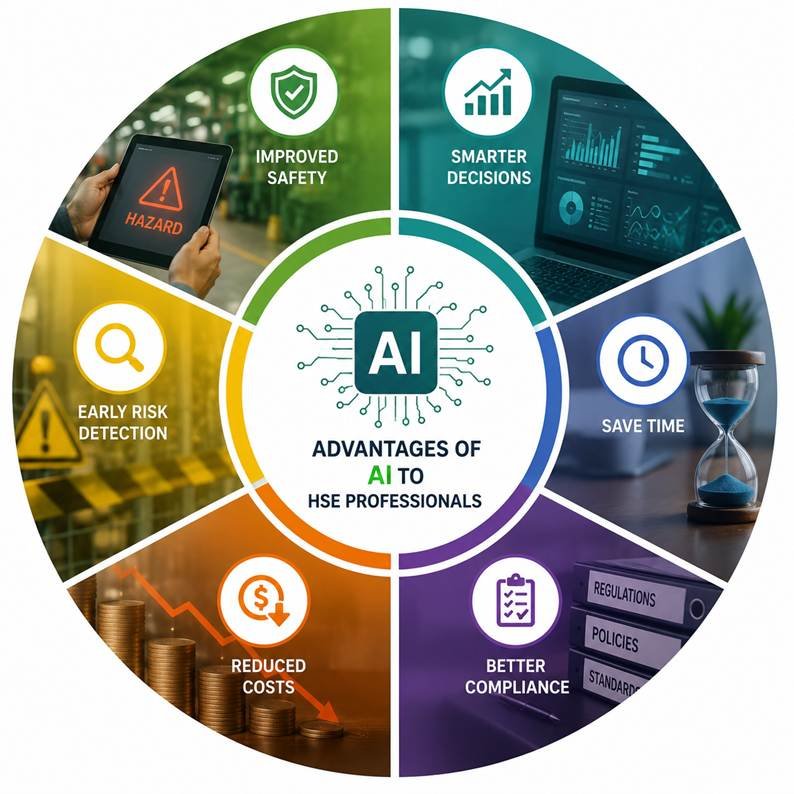
One of the most important changes AI brings is the ability to identify risk earlier. Instead of waiting for incidents to occur, AI can analyze observations, audit findings, incident reports, sensor data, and other inputs to detect patterns that may signal trouble ahead. This gives safety teams a better chance to intervene before a hazard becomes an injury, spill, or compliance issue.
AI is also improving real-time monitoring. Computer vision systems can identify unsafe behaviors, missing PPE, or hazardous conditions as they happen. In high-risk environments, that immediate visibility can make a meaningful difference. It allows supervisors and safety leaders to respond faster and prevent small issues from escalating.
Another major advantage is compliance support. Environmental, health, and safety regulations change frequently, and keeping up manually can be difficult. AI can help streamline reporting, highlight gaps, and reduce the burden of repetitive administrative work. That frees EHS teams to focus more time on prevention and improvement.
AI is also helping organizations investigate incidents more effectively. By analyzing historical data and related records, it can surface likely root causes and recommend corrective actions. This improves consistency and helps teams move more quickly from incident response to long-term prevention.
Ethical Considerations of AI in Workplace Safety
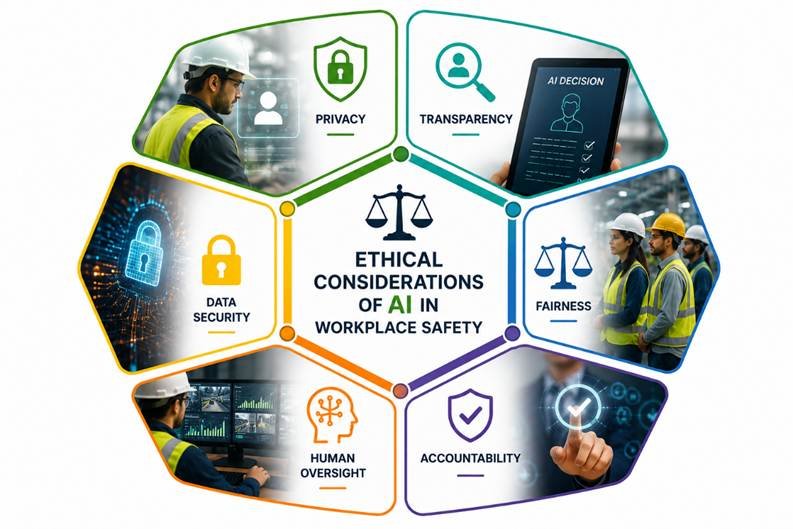
AI in workplace safety raises ethical issues around privacy, fairness, transparency, accountability, and worker dignity, even when it improves hazard detection and monitoring. The core challenge is to use AI to reduce harm without turning safety systems into intrusive surveillance or biased decision-making tools. A responsible workplace AI program should have clear rules on data minimization, purpose limitation, access control, and retention. It should also include worker consultation, training for supervisors and employees, regular bias testing, and a human override for safety-critical decisions. For higher-risk uses like health monitoring or behavioral surveillance, stronger governance and more explicit consent mechanisms are especially important.
Main Ethical Issues
Privacy and data protection: AI safety tools often rely on wearables, cameras, sensors, and communication data, which can expose sensitive personal information if collected or stored carelessly.
Bias and discrimination: If AI is trained on incomplete or skewed data, it can produce unfair risk scores or uneven enforcement across worker groups.
Transparency and explainability: Workers and managers should be able to understand why an AI system flagged a hazard, rated a person as high risk, or recommended an intervention.
Accountability: Organizations remain responsible for safety outcomes, so AI should support human judgment rather than replace it.
Dignity and agency: Constant monitoring can make workers feel controlled, reduce trust, and create stress or fear about discipline or job loss.
Best AI Tools for EHS Compliance Management
The best fit depends less on “AI” as a label and more on the exact job: audits, incident reporting, document extraction, or real-time hazard detection.
For EHS compliance management, the strongest AI-enabled options, depending on management compliance are-
Cority: Best for large enterprise EHS programs needing broad compliance tracking and structured workflows.
Intelex: Strong for configurable safety and quality management in manufacturing and chemicals.
Protex AI: Best for real-time video analytics and unsafe-behavior detection.
Visionify: Good when you want to leverage existing CCTV for PPE, fall-risk, and unsafe-action detection.
SafetyCulture iAuditor: Useful for mobile inspections, checklists, and audit readiness with AI-enhanced workflows.
CloudApper EHS: Helpful for AI-assisted Q&A, inspections, reporting, and corrective actions.
Energent.ai: Best when your bottleneck is unstructured compliance data, scanned reports, and PDF-heavy workflows.
What to Choose – Selection Criteria
For EHS use, for a safety-critical environment, human oversight should remain mandatory for all AI-generated recommendations.
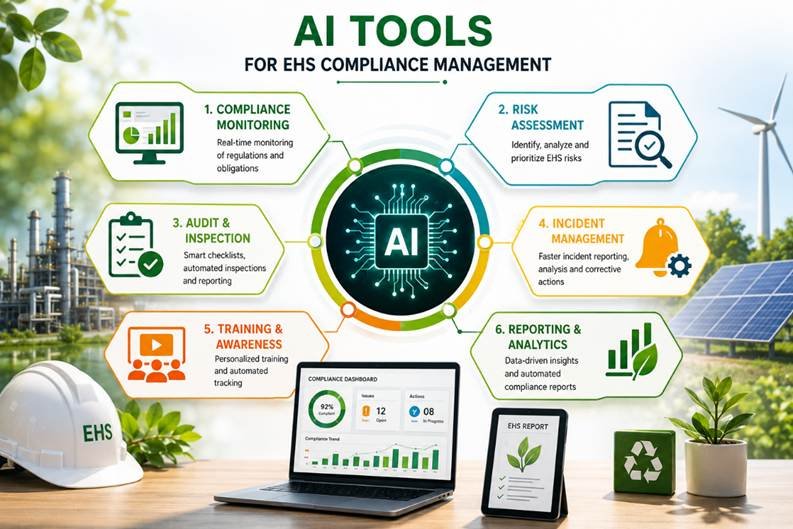
A practical shortlist should test for these factors:
- Regulatory coverage for the regions you operate in.
- Audit trail quality and document control.
- Mobile inspection support for frontline use.
- Integration with CCTV, IoT, HR, or ERP systems.
- Data privacy, role-based access, and explainability of AI outputs.
Practical Takeaway
Artificial Intelligence is transforming Health, Safety, and Environment (HSE) management by shifting strategies from reactive (responding to accidents) to proactive (preventing them).
In HSE terms, AI is best treated as a decision-support layer, not an autonomous authority. The safest ethical model is one where AI helps identify hazards faster, while people retain control over interpretation, escalation, and corrective action.
==================================================
Join Ken Institute now to advance your career with Higher Certification in Health & Safety Courses !
Internationally recognized courses and training programs designed to empower individuals and organizations. Our commitment is “academic excellence, quality standards, and robust training processes”.
Connect now and take the next step toward professional excellence!
+91 7569034271
Let’s connect together on: Facebook, YouTube, LinkedIn, and Instagram.