Fire risk assessment (FRA) in industrial workplaces is a core process safety discipline that prevents catastrophic incidents. Industrial fires often stem from uncontrolled ignition sources interacting with significant fire loads. Consequences extend beyond property loss to include injuries, fatalities, production downtime, regulatory penalties, and reputational damage.
The best practices to eliminate fire risk is the Robust FRA methodology, expanded dust hazard analysis (DHA), and prevention strategies aligned with NFPA 30 (flammable liquids), NFPA 652/660 (combustible dust), API 2218 (fireproofing), NFPA 11 (foam systems), and industry best practices.
FRA in Industrial Chemical and Process Plants
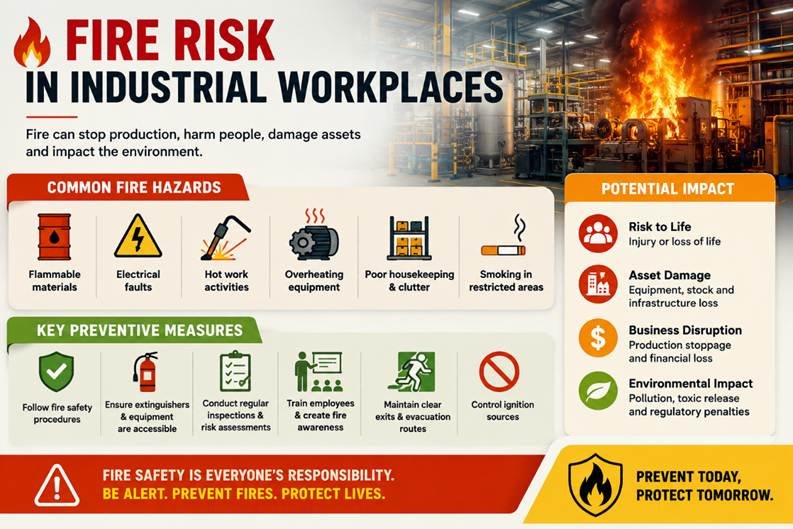
Chemical and process facilities face unique fire and explosion challenges such as:
High fire loads: Bulk storage of solvents, fuels, intermediates, and finished products.
Vapour hazards: Flammable vapours can travel and ignite far from the liquid source, creating flash fires or VCEs.
Complex release scenarios: Leaks from pumps, flanges, valves, and vessels can form pool fires, jet fires, or explosive clouds.
Dust risks: Powders and particulates (e.g., polymers, pigments, APIs, intermediates, sulfur, metal powders) can cause dust explosions if not managed.
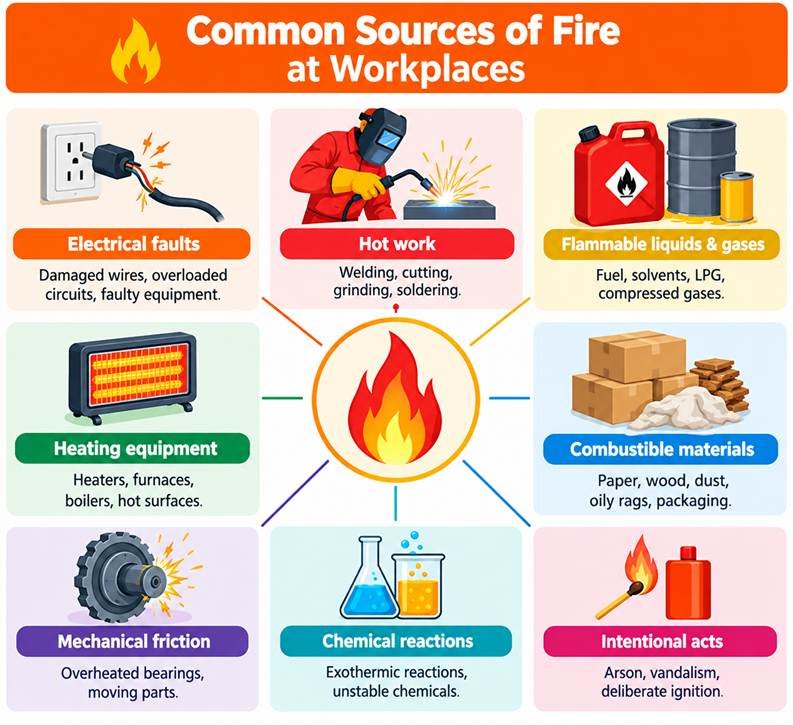
Consequences extend beyond asset damage to include major injuries, fatalities, environmental releases, regulatory action, and prolonged shutdowns.
A Process-Specific FRA Methodology
A Fire and Explosion Risk Analysis (FERA) approach, which integrates process safety with fire protection engineering.
1) Information Gathering and Hazard Identification (HAZID)
Start with a structured review of:
Process flow diagrams (PFDs) and piping & instrumentation diagrams (P&IDs) to understand material flows, pressures, temperatures, and relief systems.
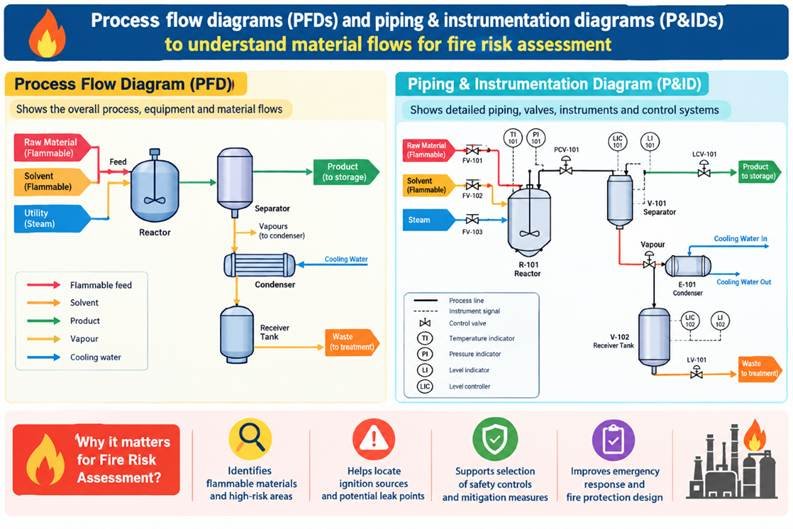
Inventory and properties: Identify flammable/combustible liquids (per NFPA 30 classes), gases, vapours, and combustible dusts.
Dust characterization: For each particulate solid, confirm whether it is combustible and explosible via laboratory testing (ASTM/NFPA protocols).
Release sources: Pumps, seals, flanges, valves, sampling points, vents, transfer operations, mills, grinders, sifters, blenders, conveyors, and dust collectors.
Output: A hazard register listing materials, quantities, locations, and potential release/ignition.
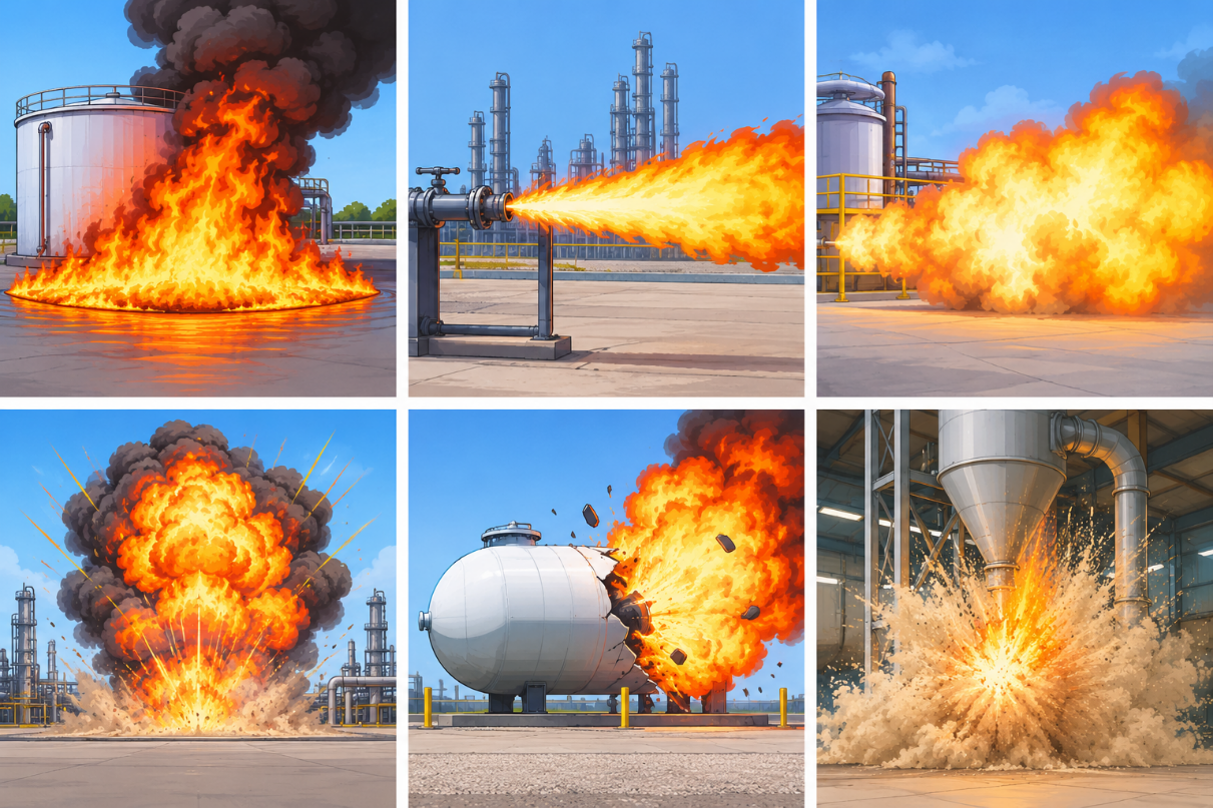
2) Scenario Development: Fire and Explosion Archetypes
Evaluate credible worst-case and frequent scenarios, such as:
Pool fire: Spill of flammable liquid forming a burning pool (e.g., tank overflow, hose rupture).
Jet fire: Pressurized gas/liquid release igniting as a directed flame (e.g., pipe leak, relief valve discharge).
Flash fire: Rapid ignition of a flammable vapour cloud with short-duration but high heat flux.
Vapour cloud explosion (VCE): Ignition of a large, confined/semi-confined vapour cloud causing overpressure damage.
BLEVE: Boiling liquid expanding vapour explosion from pressurized vessels exposed to fire.
Dust explosion: Deflagration in conveyors, silos, filters, mills, grinders, blenders, or process equipment handling combustible dusts.
“For each scenario, define the release source, ignition source, and affected equipment/personnel.”
3) Frequency and Consequence Analysis
Frequency: Estimate likelihood using historical data, leak frequencies, maintenance records, operational controls and housekeeping performance for dust.
Consequence: Model fire exposure (heat flux, duration) and explosion overpressure to assess:
Structural vulnerability (steel supports, pipe racks, vessels, buildings).
Equipment damage and escalation potential (domino effects).
Occupant risk (tenability, egress time).
For dust hazards, use Kst and Pmax to size explosion protection (venting, suppression, isolation) and evaluate building damage potential.
Use this to derive Design Accidental Loads (DeALs)—the fire/explosion loads that structures and safety systems must withstand.
4) Evaluate Existing Controls (Process + Fire Protection)
Review both process safety and fire protection layers:
Process Safety Controls
Inherently safer design (minimize inventory, substitute less hazardous materials).
Relief systems, interlocks, emergency shutdown (ESD), and isolation valves.
Ventilation, inerting (nitrogen/CO₂), and concentration control for dusts.
Enclosed conveying and dust collection systems to contain and capture dust at source.
Fire Protection Systems
Foam systems (NFPA 11) for flammable liquid tanks, loading bays, and process areas where water alone is inadequate.
Sprinkler/deluge systems sized for the specific hazard (e.g., high-challenge storage, outdoor process units).
Gas/vapour detection (LEL monitors) and flame detectors in classified zones.
Fireproofing of structural steel per API 2218 where fire exposure could cause collapse or escalation.
Secondary containment (dikes, bunds) and drainage to limit spill spread.
Explosion protection for dust: vent panels (NFPA 68), suppression systems (NFPA 69), isolation devices (rotary valves, flame arrestors), and spark detection/extinguishment in ducts.
5) Risk Reduction Measures (Hierarchy of Controls)
Prioritize actions using the hierarchy of controls, tailored to process and dust hazards:
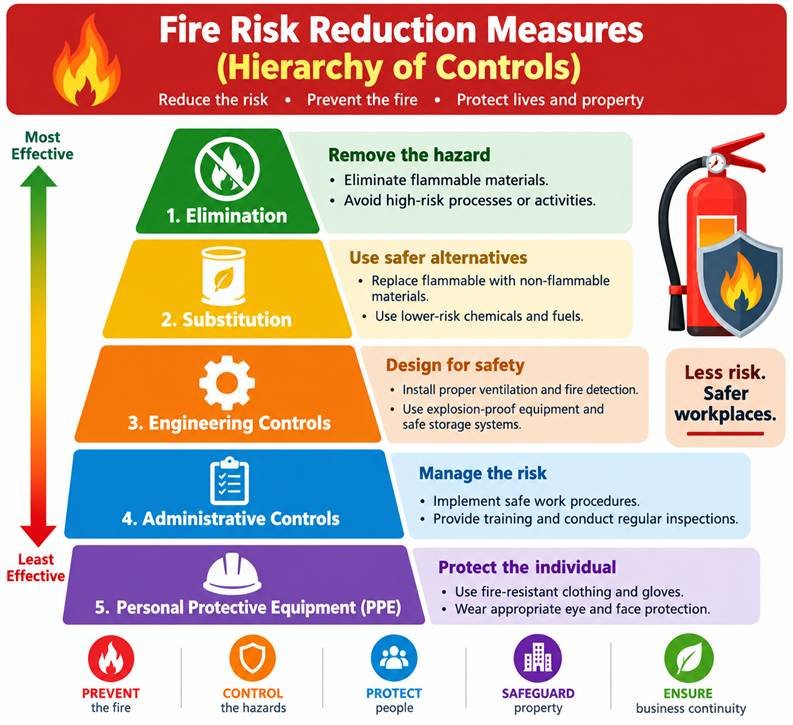
Eliminate/Reduce Hazard: Reduce inventory in process areas; substitute high-vapour-pressure solvents or highly sensitive powders where feasible.
Engineering Controls:
Install/upgrade foam-water systems for tank farms and loading areas.
Add gas detection with automatic isolation and ventilation interlocks.
Apply fireproofing to critical supports and vessels per API 2218.
Implement dust explosion protection (venting, suppression, isolation) in conveying, milling, and storage systems.
Use enclosed conveyors and local exhaust to capture dust at source; maintain minimum transport velocities in ducts to prevent settling.
Administrative Controls:
Strict permit-to-work for hot work, line breaking, and tank entry.
LDAR programmes to detect and repair leaks proactively.
Housekeeping standards for dust and spill control (no compressed air for cleaning; use explosion-proof vacuums).
Written SOPs for high-hazard operations (milling, grinding, sifting) with interlock checks and daily inspections.
PPE: Flame-resistant clothing (FRC) for personnel in flash fire/dust explosion zones; respiratory protection where needed.
6) Documentation and Integration with PHA/DHA
- Integrate FRA/FERA outputs with:
- Process Hazard Analysis (PHA) for highly hazardous chemicals.
- Dust Hazard Analysis (DHA) for combustible particulates, as required by NFPA 652/660.
- A DHA is a systematic review to identify and evaluate fire, flash fire, and explosion hazards associated with combustible particulate solids in a process or facility. It must:
- Identify all areas where combustible dust is generated, handled, or stored.
- Evaluate existing safeguards (containment, capture, cleaning, ignition control, explosion protection).
- Recommend additional controls and document them for each process.
- Be performed by a qualified person and updated when materials, equipment, or processes change.
- Maintain an FRA/DHA report that includes:
- Facility/process description and hazard inventory (liquids, gases, dusts).
- Scenarios analyzed, assumptions, and DeALs.
- Dust testing data (Kst, Pmax, MIE, MEC) and classification (St1/St2/St3).
- Control gaps and mitigation plan with owners/dates.
- Review schedule (triggered by process changes, incidents, or periodic intervals).
Dust Hazard Analysis (DHA) in Industries
A Dust Hazard Analysis (DHA) is a structured, facility-wide assessment required by NFPA 652/660 for any site handling combustible particulate solids.
In chemical plants, DHAs are critical because many intermediates, APIs, pigments, polymers, and additives are fine powders that can form explosible clouds in mills, grinders, sifters, blenders, conveyors, silos, and dust collectors.
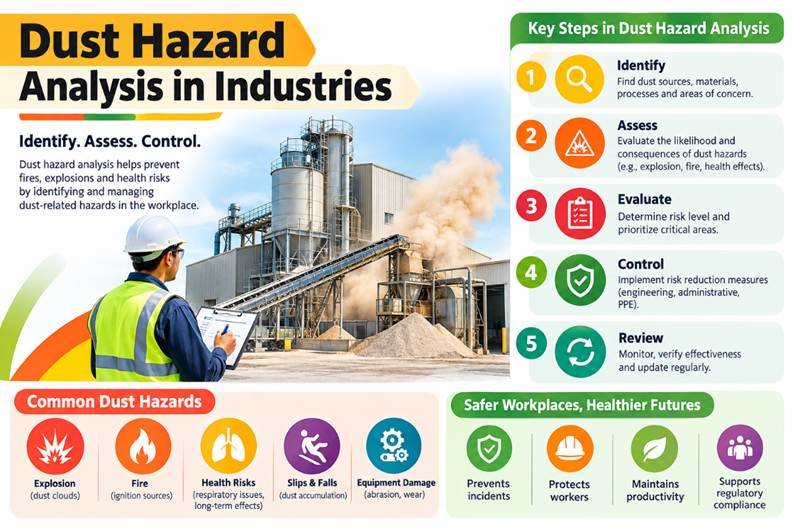
A DHA answers:
Where is combustible dust present?
How is it generated, transported, and stored?
What ignition sources exist (electrical, mechanical, static, hot surfaces)?
Are current controls adequate to prevent or mitigate explosions?
DHA Process
Step 1: Dust Identification and Testing
Step 2: Process Mapping and Hazard Scenarios
Step 3: Evaluate Existing Controls (The “Three Cs”)
Contain: Dust inside process equipment
Capture: Ensure ductwork maintains minimum transport velocity to prevent settling.
Clean: Implement rigorous housekeeping to remove dust.
Step 4: Explosion Protection Design, measures per NFPA 68/69:
Step 5: Ignition Source Control.
Use dust-rated (ATEX/IECEx) electrical equipment in hazardous areas. Enforce hot-work permits and isolate equipment before maintenance.
Step 6: Administrative Controls and Training
Train operators on dust hazards, housekeeping standards, and emergency response.
Step 7: Documentation and Review
Document all findings, controls, and recommendations in the DHA report.
Update the DHA whenever materials, equipment, or processes change; revalidate periodically.
Best Practices for Prevention Fire Risk in Industrial Workplaces
Flammable Liquids and Storage Tanks (NFPA 30 Focus)
Segregate and limit quantities: Store Class I flammable liquids in approved tanks/cabinets with secondary containment; minimize day-tank volumes in process areas.
Separation distances: Comply with NFPA 30 Chapter 22 for distances between tanks, buildings, and property lines; provide fire-rated barriers where needed.
Foam protection: Install fixed foam chambers or subsurface injection for atmospheric tanks; ensure maintenance per NFPA 11.
Vapour control: Use vapour detectors in tank farms and loading bays; ensure adequate ventilation and vapour recovery where applicable.
Process Units and Piping Systems
Leak prevention: Implement mechanical integrity programmes and LDAR to catch leaks early.
Ignition source control: Use ATEX/IECEx-rated electrical equipment in classified zones; enforce hot-work permits and isolation procedures.
Relief and flare systems: Ensure relief devices discharge to safe locations with flame arrestors where needed.
Fireproofing: Apply fireproofing to structural steel and pipe supports in high-exposure zones per API 2218 .
Foam and deluge systems: Protect high-hazard units with foam-water or deluge systems designed for the specific fire scenario.
Emergency isolation: Install remotely operated isolation valves to stop flow to fire zones.
Integrating FRA/DHA with Maintenance and Digital EHS
Integration of FRA and DHA actionable and dynamic:
CMMS-linked inspections: Schedule fire/explosion system checks and tie findings to corrective work orders with escalation.
IoT and analytics: Use continuous gas monitoring with calibrated sensors; add temperature/vibration monitoring, feed data to a central dashboard for trend analysis and early warning.
Digital permits and audits: Implement e-permit-to-work for hot work, line breaking, and tank entry, with checklists derived from FRA/DHA controls.
Risk reviews: Periodically update FRA/FERA and DHA to reflect process changes, new materials, or incident learnings; link to PHA revalidations.
This integration turns FRA/DHA into living risk management tools that reduce both likelihood and consequence of fire/explosion events.
Final Thought
In chemical and process manufacturing, fire risk assessment must be deeply integrated with process safety and dust hazard management. A FERA-style approach, grounded in NFPA 30, NFPA 652/660, API 2218, and NFPA 11, combined with strong prevention practices delivers the highest return in risk reduction and operational resilience.
Join Ken Institute,
unlock a world of online courses in MBA in HSE, Occupational Health and Safety, Fire Safety, Mechanical Engineering, and Environment and Sustainability.
Internationally recognized courses and training programs designed to empower individuals and organizations.
Join Ken Institute now to advance your career with Higher Certification in Fire Safety Courses
Connect now and take the next step toward professional excellence!
+91 7569034271
Let’s connect together on: Facebook, YouTube, LinkedIn, and Instagram.