
Fires kill more people annually than floods, hurricanes, tornadoes, and earthquakes combined. The prime motive of fire protection is to preserve life safety. A secondary goal is to protect property and safeguard the environment. These are achieved by engineered the buildings and escape routes to prevent the spread of fire and smoke, and to minimize structural damage, considering all the “Fire Facts”.
-
Fire
Fire is a chemical reaction in which Heat, Light, and Smoke is evolved. To generate fire, Heat, Fuel and Oxygen is essentially required in balanced ratio. Shortage of any one restricts occurrence of fire.
-
The Fire Triangle
Three things must be present at the same time to produce fire:
- Enough OXYGEN to sustain combustion
- Enough HEAT to reach ignition temperature
- Some FUEL or combustible material Together, they produce a CHEMICAL REACTION that results in a “FIRE”
If one of these components is missing, a fire can’t ignite.
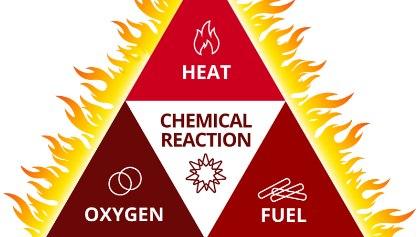
Take away any ONE of these and the fire will be …………….. E X T I N G U I S H E D
-
General Fire Facts
- Smoking is the primary cause of fatal fires. The second most common cause of fatal fires is Heating Equipments in the kitchens and industries and the third is Arson in commercially-operated buildings.
- Fire doubles every 60 seconds.
- Over 2 million fires are reported to fire departments each year alone in the developed country like USA.
- There are over Ten Billion Dollars in property damages in the USA each year from fire.
- Despite the use of sprinklers and smoke alarms, the fire fatality rate is the worst in the industrialized world.
- In deadly home fires only14% had working smoke detectors and alarms.
- Smoke detectors failed to operate in 44% of reported fires.
- Almost 40% of fire victims die in their sleep.
- It can take less than 30 seconds for a fire to become difficult to control.
- More people die from smoke inhalation than flames.
-
Some Interesting Fire Facts
- Earth is the only known planet where fire can burn.
- You have no sense of burning smell when sleeping.
- A candle flame typically burns at around 1000 Degrees Celsius.
- No one knows who invented the fire hydrant, because its patent was destroyed in a fire.
- Cotton will catch on fire if super glue is applied to it.
- You can start a fire using ice.
- A typical house fire will double in size every minute.
- Firefighting was actually a sport at the 1900 Olympics in Paris.
Science Behind the Fire Facts
-
Classification of Fire
Class “A” Fire – Fires Involving ordinary combustible material (Such as wood, Cloth, Rubber and many Plastics) requiring the heat absorbing (cooling) effects of water, water solution, or the coating effects of certain dry chemicals which retard combustion.
Class “B” Fire – Fires involving flammable or combustible liquids, flammable gases, greases and similar materials where extinguishment is most readily secured by excluding air (Oxygen), inhibiting the release of combustible vapours or interrupting the combustion chain reaction.
Class “C” Fire – Fire involving gaseous substance under pressure where it is necessary to dilute the burning gas at a very fast rate with an inert gas or powder.
Class “D” Fire – Fires involving certain combustible metals (such as magnesium, Titanium, Zirconium, Sodium, Potassium etc.) requiring a heat absorbing extinguishing medium not reactive with burning metals.
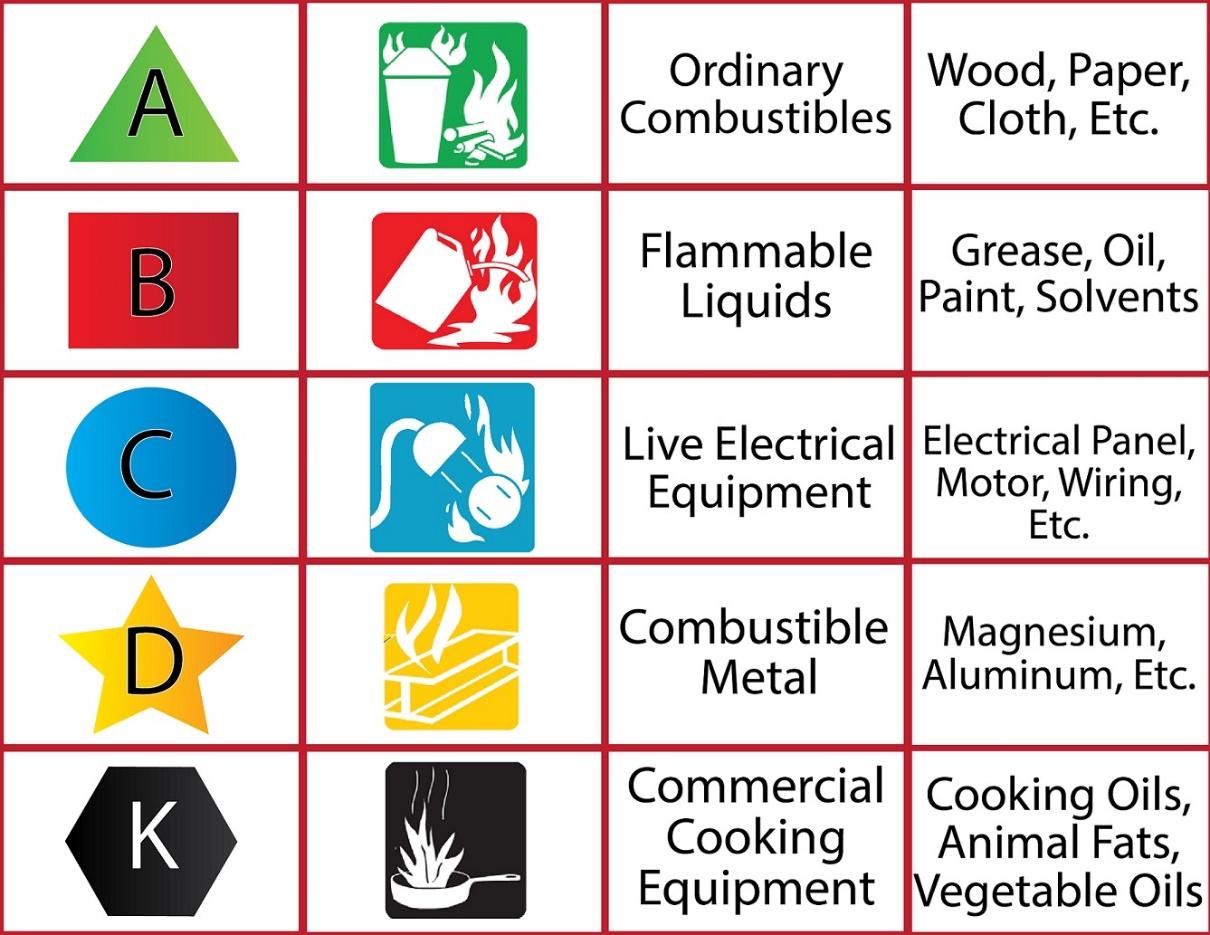
Class K fires- involve vegetable oils, animal oils, or fats in cooking appliances. Requiring a fine wet mist consisting of an alkaline mixture, such as potassium acetate, potassium carbonate, or potassium citrate that forms a soapy foam as it is applied to the cooking oil or other substance.
-
The Fundamental Stages of a Fire
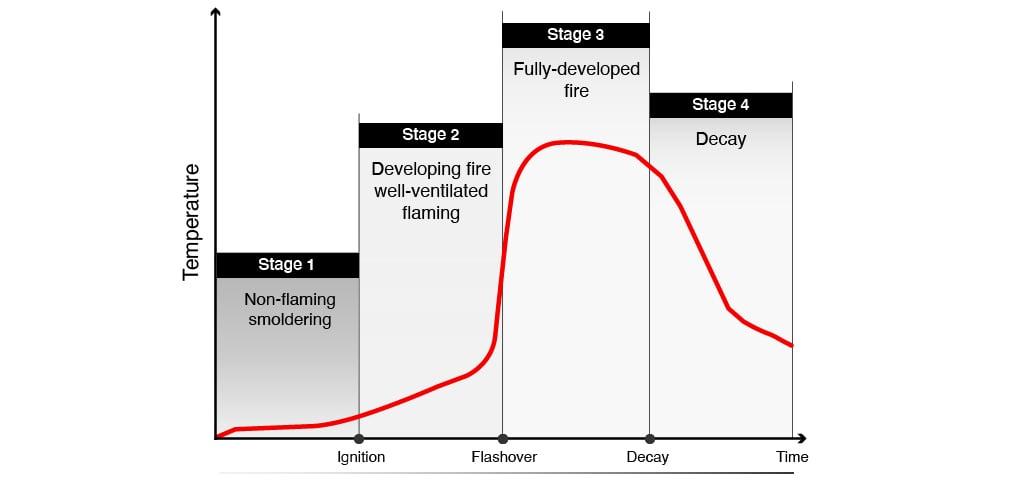
There are 4 fundamental stages in a natural fire.
- The Incipient Ignition Phase– wherein heating of the potential fuel source(s) takes place.
- The Growth Stage- which involves ignition with visible flaming combustion. As the fire grows and reaches sufficiently high temperatures (about 1,100 °F / 600 °C) it may “flashover” condition.
- The Burning Period- This most severe stage of the fire causes the greatest effects on the building elements. The temperatures and heat flux are so great within the fire compartment that all exposed surfaces are burning and the available ventilation will govern the rate of heat release. A fully developed fire will likely not exceed 1,500 °F (815 °C), though it could range up to a peak of 2,000 °F (1,093 °C) under more severe conditions. The maximum temperature will typically last for only 10 to 20 minutes during the peak of its burning period within the compartment.
- The Decay Period- This phase is generally begins when about 70 percent of the combustible materials in the compartment have burned.
-
Flashover
“Flashover” is the abrupt transition from relatively light burning of a small number of combustibles in the room, or a small portion of the room, to full-room involvement in fire, all of the combustible contents of the room experience a nearly simultaneous ignition, with very visible flaming throughout.

- Effects Required for Fire Extinction
- For eliminating HEAT a COOLING effect is required.
- For removal of FUEL a STARVATION effect is required
- For exclusion of OXYGEN a SMOTHERING / BLANKETING effect is required.
-
How To Put Out A Fire
Heat can be generated by any source. Fuel can be anything combustible, such as wood, paper, clothing, furniture, gases or chemicals.
- Once a fire starts, if any of the three components is removed, the fire is extinguished.
- Water is used to cool a fire and take away the heat source.
- Oxygen can be removed by smothering a fire with dirt, sand, a chemical agent or a blanket.
- Fuel can be removed by moving combustible materials away from the fire or by simply waiting until the fire consumes the material and goes out of its own accord.

Considering all these fire Facts, the most effective means for fire safety can be provided either for prevention of fire ignition altogether, or extinguishment of the fire during the early growth stage.
Our Passion is to create a safe, well-protected environment around you! Above mentioned Fire Facts will definitely help you at emergency situation.
For the top-level Fire Safety training, more advice or any personalized information get in touch with us at info@keninstitute.com
or visit us at www.keneducation.in or call us at +917569034271
Let’s connect with us on Facebook, YouTube, LinkedIn, Instagram.