
Hazardous Waste Operations and Emergency Response
“HAZWOPER” is a set of guidelines produced and maintained by the Occupational Safety and Health Administration which regulates hazardous waste operations and emergency services in the United States and its territories. An unexpected release of hazardous substances, or a substantial threat of a hazardous substance release, can pose a significant health and safety risk to workers. Unexpected releases can be caused by operation failures and unrelated outside events (e.g., natural disasters, terrorism). Workers can encounter hazardous substances through waste dumped in the environment—a serious safety and health issue that continues to endanger life and environmental quality.
OSHA’s HAZWOPER Standards
To regulate hazardous wastes and dangerous goods from inception to disposal, OSHA issued “the Hazardous Waste Operations and Emergency Response Standards” to protect workers and enable them to handle hazardous substances safely and effectively. The standards codifying the health-and-safety requirements, companies must meet to perform hazardous-waste cleanup or respond to emergencies.
OSHA’s standards (in general industry, 29 CFR 1910.120; and construction 29 CFR 1926.65) established health and safety requirements for employers engaged in these operations, as well as responses to emergencies involving releases of hazardous substances.
The HAZWOPER standard covers employers performing the following general categories of work operations:
- Hazardous waste site cleanup operations
- Operations involving hazardous waste that is conducted at treatment, storage, and disposal (TSD) facilities
- Emergency response operations involving hazardous substance releases
Origin
During World War II, waste accumulated during the construction of the atomic bomb at the Hanford Site. Years later, high-profile environmental mishaps (such as Love Canal in 1978 and the attempted 1979 Valley of the Drums cleanup) spurred federal legislative action, awakening the U.S. to the need to control and contain hazardous waste.
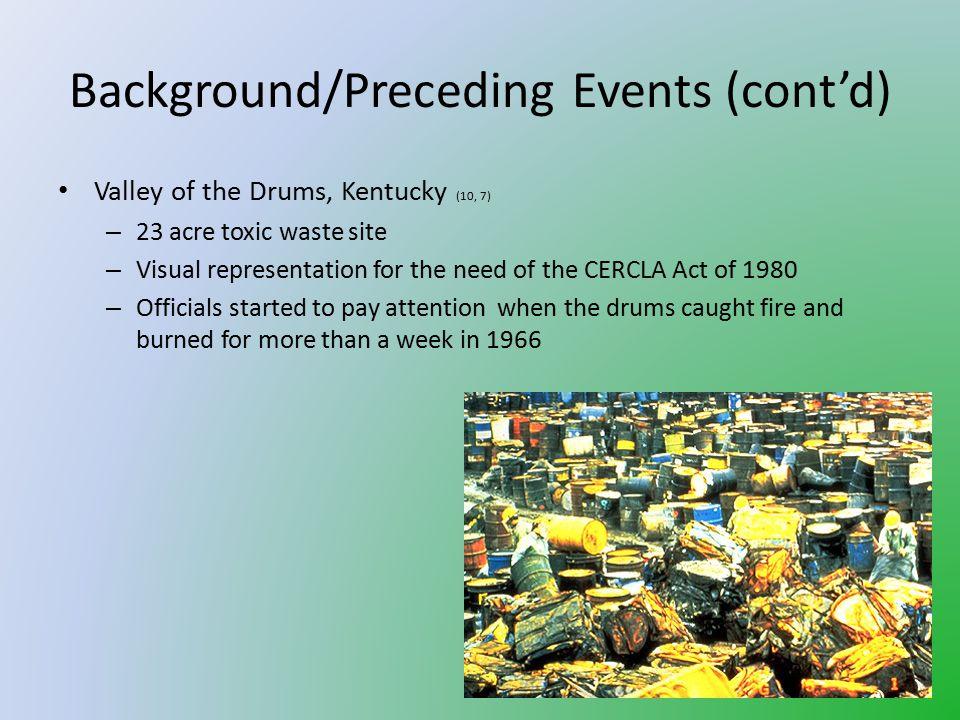
The acronym HAZWOPER was originally derived from the Department of Defense‘s Hazardous Waste Operations (HAZWOP), implemented on military bases slated for the disposal of hazardous waste left on-site after World War II. In 1989 production ended at the Hanford Site, and work shifted to the cleanup of portions of the site contaminated with hazardous substances including radionuclides and chemical waste.
OSHA created Hazardous Waste Operations and Emergency Response, with input from the Coast Guard, the National Institute for Occupational Safety and Health, and the Environmental Protection Agency (EPA).
Applications of HAZWOPER
HAZWOPER aims to prevent and minimize the possibility of worker injury and illness resulting from potential exposures to hazardous substances.
Exposures to hazardous substances pose a wide range of acute (immediate) and chronic (long-term) health effects. These may include chemical burns, sensitization, irritation, and other toxic effects that may lead to death. Hazardous substance releases can also result in fires, explosions, high-energy events, and/or toxic atmospheres depending on the physical properties and health hazards of the released substance(s).
It applies to five groups of employers and their employees. This includes employees who are exposed (or potentially exposed) to hazardous substances (including hazardous waste) and who are engaged in one of the following operations as specified by OSHA regulations.
- Cleanup operations required by a governmental body (federal, state, local, or other) involving hazardous substances conducted at uncontrolled hazardous waste sites
- Corrective actions involving clean-up operations at sites covered by the Resource Conservation and Recovery (RCRA) Act.
- Voluntary cleanup operations at sites recognized by a federal, state, local, or other governmental body as uncontrolled hazardous waste sites
- Operations involving hazardous waste which are conducted at treatment, storage, and disposal facilities regulated by the RCRA.
- Emergency response operations for releases of, or substantial threats of release of, hazardous substances.
The most commonly used manual for Hazardous Waste Operations and Emergency Response
activities, written for government contractors and first responders, list safety requirements for clean-ups and emergency-response operations.
Training Levels
OSHA recognizes several levels of training, based on the work the employee performs and the degree of hazard faced. The training would include methods used to minimize the risk from safety and health hazards; safe use of control equipment; selection and use of appropriate personal protective equipment; safe operating procedures to be used at the incident scene; techniques of coordination with other employees to minimize risks; appropriate response to overexposure from health hazards or injury to themselves and other employees; and in recognition of subsequent symptoms which may result from overexposures.
Each level requires a training program, with OSHA-specified topics and minimum training time.
- General site workers – 40 hours of instruction, three days of supervised hands-on training, and eight hours of refresher training annually.
- Workers limited to a specific task, or with no hazards above acceptable levels- 24-hour initial training, one day of supervised hands-on training, and eight hours of refresher training annually.
- Managers and supervisors – the same level of training as those they supervise, plus eight hours.
- Workers at a treatment, storage, or disposal facility handling RCRA waste – 24 hours of initial training, best practice two days of supervised hands-on training, and eight hours of refresher training annually.
- Employee members of TSD facility (Treatment, Storage, and Disposal facilities) emergency response organizations shall be trained to a level of competence in the recognition of health and safety hazards to protect themselves and other employees.
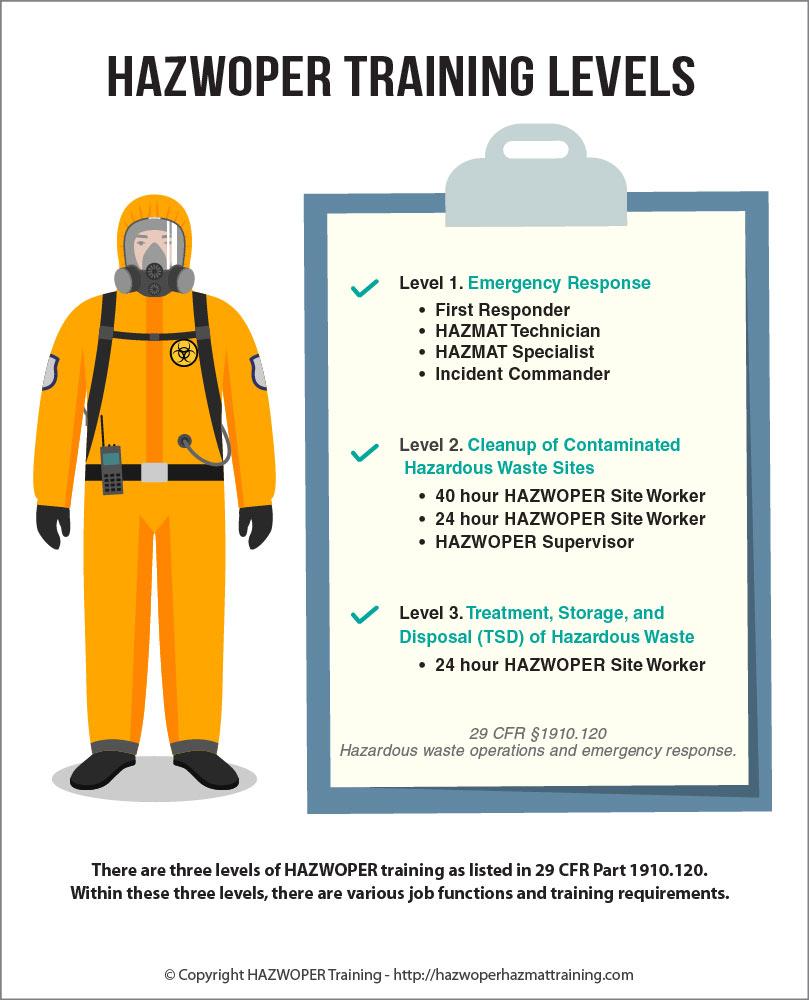
- The First Responder Awareness Level – sufficient training to demonstrate competence in assigned duties.
- The First Responder Operations Level – Awareness-Level training plus eight hours.
- Hazardous Materials Technicians – 24 hours of training plus additional training to achieve competence in specialized areas.
- Hazardous Materials Specialists – 24 24-hour training at the Technician level, plus additional specialized training.
- On-scene Incident Commanders – 24 hours of training plus additional training.
An employer must ensure that the training provider covers the areas of knowledge required by the standard and provides certification to students that they have passed the training.
Operations Covered by Hazardous Waste Operations and Emergency Response
The term “emergency response” often applies generally to any activity requiring immediate attention. Under HAZWOPER, this term applies specifically to response activities where there is an uncontrolled release of a hazardous substance, or where an uncontrolled release is likely. There are a multitude of scenarios and incidents that could result in the release of hazardous substances.
Five distinct operations fall within the scope of the HAZWOPER standard:
- Cleanup operations required by a governmental body, involving hazardous substances conducted at uncontrolled hazardous waste sites.
- Corrective actions involving cleanup operations at sites covered by the Resource Conservation and Recovery Act.
- Operations involving hazardous waste conducted at treatment, storage, and disposal (TSD) facilities regulated under RCRA.
- Operations that generate hazardous waste but are not TSD facilities.
- Emergency response operations involving releases of, or substantial threats of releases of hazardous substances, without regard to the location of the hazards.
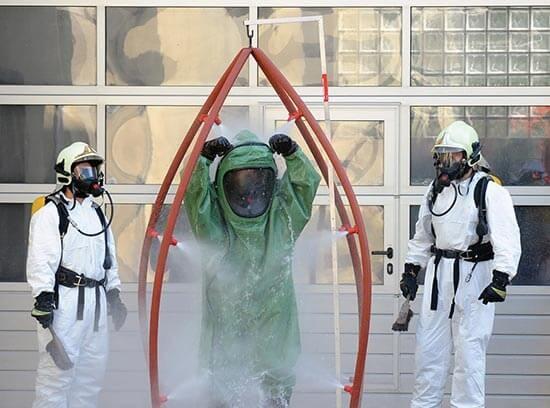
Emergency response operations can occur at public and private facilities, research laboratories, universities, chemical facilities, railroads, roads/highways, and any location with the potential for accidental releases of hazardous substances. Work to contain and control such hazardous substance releases on an emergency basis, when the exact nature and extent of the hazards are unknown, is regulated under the HAZWOPER standard.
“Join Ken Institute for comprehensive Health and Safety courses led by expert faculty, ensuring your readiness to tackle workplace fire emergencies effectively.”
To protect your people from exposure to dangerous chemicals and to broaden your understanding of health and safety topics,
join us at info@keninstitute.com or
visit our website www.keneducation.in or
call on +917569034271
Let’s connect on Facebook, YouTube, LinkedIn, and Instagram.