
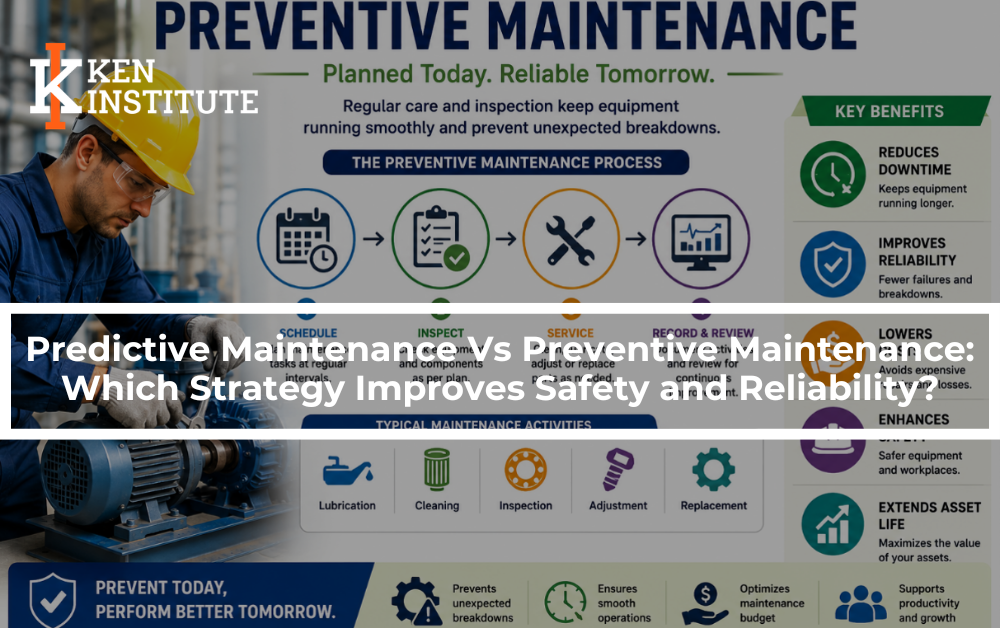
Predictive Maintenance generally improves reliability more, while Preventive Maintenance is often the safer and more practical choice when you need a simple, disciplined baseline program.
The strongest approach for most operations is a hybrid: preventive maintenance for routine assets and predictive maintenance for critical equipment where failure consequences are high.
Predictive Maintenance (PDM) Vs Preventive Maintenance (PM)
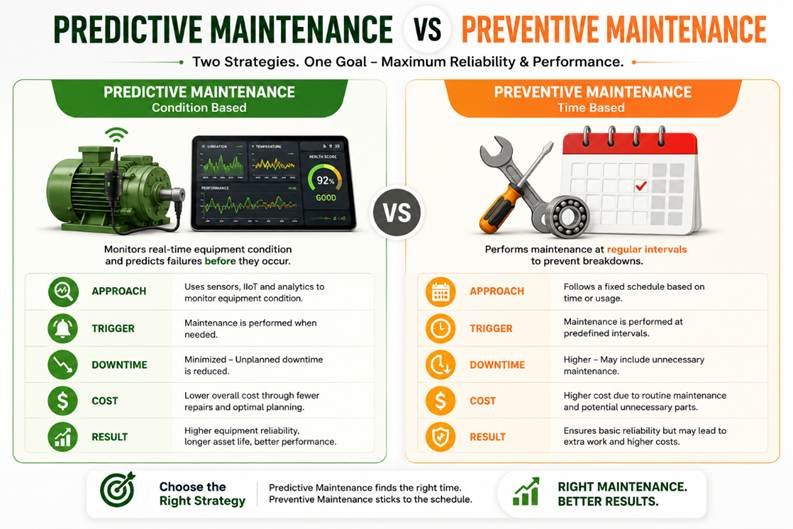
Predictive maintenance is condition-based, using live data such as vibration, temperature, or oil condition to intervene only when failure is becoming likely.
Preventive maintenance is time- or usage-based, so work is done on a fixed schedule whether the asset shows degradation or not.
Safety Impact
For safety, predictive maintenance has an edge when equipment failure could create serious hazards, because it can catch abnormal degradation before a breakdown becomes dangerous. In industrial settings, predictive methods are better for critical rotating equipment, process assets, and hidden degradation risks
Preventive maintenance still improves safety by reducing the chance of unexpected failures, but it can also replace parts too early or miss random failure modes that do not follow a fixed wear pattern. In industries preventive methods remain very effective for simpler, lower-criticality assets.
Reliability and Cost
Predictive maintenance usually delivers higher reliability because it targets maintenance at the optimal point before failure rather than on a calendar schedule. Tough it needs more investment in sensors, analytics, and skilled staff, it also tends to produce better long-term savings. Preventive maintenance is cheaper, easier to implement, and easier to standardize across large fleets. It often performs better as a foundation program.
More Effective Strategy
Predictive maintenance usually is more precise and better at preventing failure-driven incidents. While preventive maintenance is the more practical starting point, easier and more universally deployable
Practical Recommendation
- Predictive maintenance usually delivers the higher long-term ROI, while preventive maintenance often gives the quicker and cheaper first return. The best choice depends on asset criticality, failure consequence, and whether condition data can be captured reliably.
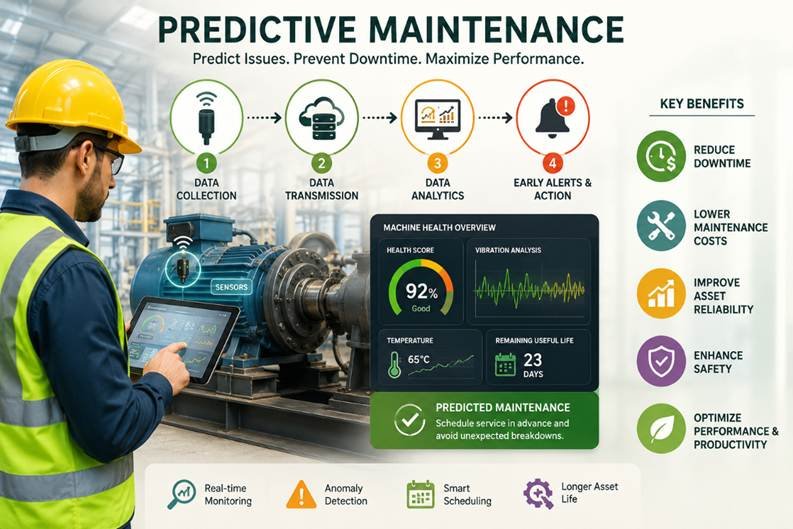
- Use preventive maintenance for assets with predictable wear, low-to-medium criticality, and limited monitoring needs.
- Use predictive maintenance for high-consequence assets, bottleneck equipment, and machines with measurable condition indicators.
- Use both together where possible, with preventive tasks covering the baseline and predictive monitoring refining the timing for critical assets.
Integration of Preventive and Predictive Maintenance Strategies
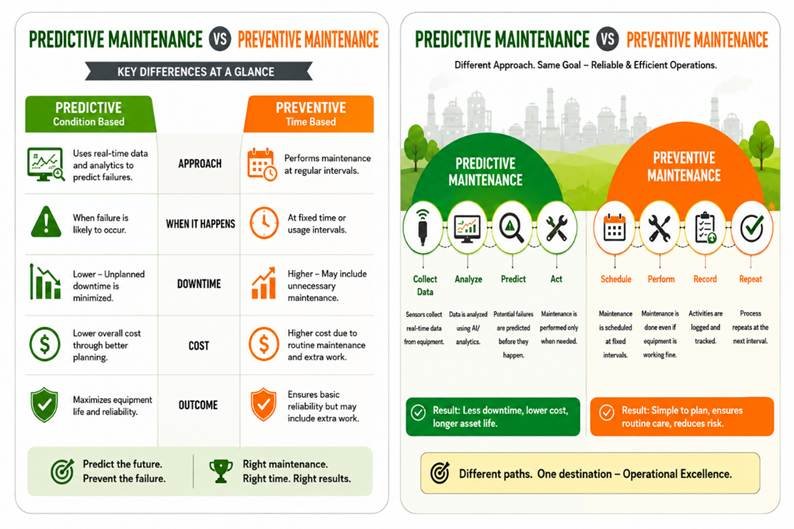
Integrate preventive and predictive maintenance by using preventive maintenance as the baseline and predictive maintenance as the refinement layer for critical assets. That means, keep time-based tasks for assets with known wear patterns, and add condition monitoring where failure consequences, downtime costs, or safety risks are high.
Practical Integration Steps
Classify assets by criticality. Put rotating equipment, bottleneck units, and safety-critical machines in the top tier for condition monitoring, while leaving simpler assets on scheduled PM.
Map failure modes: Use FMEA (Failure Mode and Effects Analysis) or RCM (Reliability Centered Maintenance) logic to decide which assets benefit from time-based tasks and which need condition-based triggers.
PM/PdM split: Use PM for routine inspections, lubrication, calibration, and statutory tasks; use PdM for vibration, temperature, ultrasound, oil analysis, and motor-current monitoring.
Connect PdM to work orders: Feed alarm thresholds and anomaly detection into the CMMS (Computerized Maintenance Management System) so predictive alerts automatically generate work requests before failure.
Review intervals with data: Use PdM findings to extend, shorten, or remove fixed PM tasks that are too early, too late, or redundant.
Track common KPIs (Key Performance Indicators): Monitor downtime, maintenance cost, mean time between failures, false alarms, and % of maintenance that is planned versus unplanned.
A practical rule: keep PM for compliance and predictable wear, and use PdM only where the extra sensing and analytics pay back in reliability or risk reduction. Many organizations start by applying PdM to the most critical 10%–20% of assets, then expand once the program proves value.
What Makes the Integration Work
The integration works best when maintenance, operations, and reliability teams agree on alarm limits, response times, and ownership of alerts. It also needs clean asset data, a disciplined work-order process, and a feedback loop so every failure or false alarm improves the maintenance plan.
Typical ROI (Return On Investment) Differences Between Predictive and Preventive Maintenance
Typical ROI is usually higher for predictive maintenance on critical assets, but faster and simpler for preventive maintenance on lower-complexity equipment. A practical rule is: preventive maintenance often pays back sooner, while predictive maintenance tends to deliver larger long-term value when failure costs are high.
Typical ROI pattern
Preventive maintenance: commonly cited around 5:1 ROI or roughly $5 returned for every $1 invested in some industry summaries.
Predictive maintenance: often reported in the range of 10:1 to 30:1 ROI for high-criticality assets, with payback commonly around 12–18 months.
Implementation Cost: predictive systems usually require 3–4x higher upfront investment than preventive programs because of sensors, analytics, and integration.
Why Predictive Can Win:
Predictive maintenance reduces unplanned downtime more aggressively, often cited at 30–50%, and can extend asset life by 20–40% in suitable applications. That stronger operational impact is why its ROI can exceed preventive maintenance, especially where one failure causes major production loss or safety exposure.
Why Preventive Still Matters:
Preventive maintenance usually has lower startup cost, simpler deployment, and a shorter path to value, which makes it attractive for broad fleet coverage and compliance-driven assets. For low-cost or easy-to-replace equipment, preventive maintenance may produce the better economic return because the added predictive infrastructure is not justified.
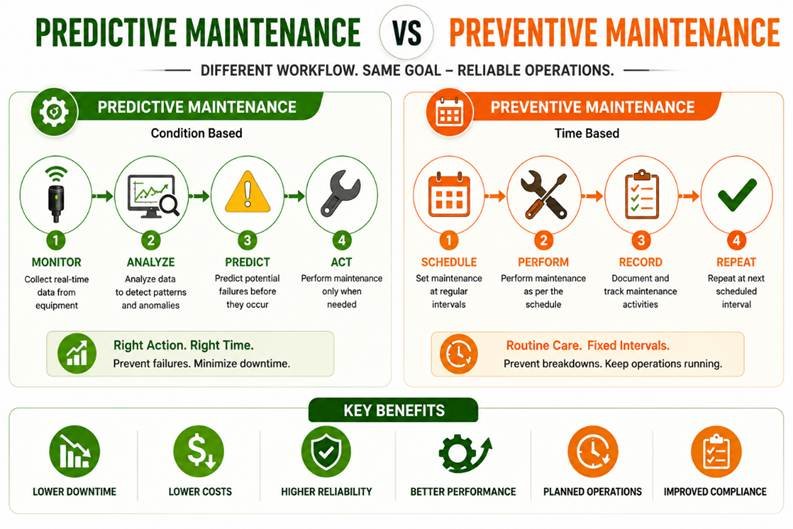
Table: An Executive-Summary for HSE Or Reliability Report
| Metric | Preventive Maintenance | Predictive Maintenance | Executive Interpretation |
| ROI profile | Typically lower than predictive, but easier to realize quickly | in the range of 10:1 to 30:1 ROI for high-criticality assets | Predictive offers stronger upside where failure cost is high. |
| Payback period | Shorter and more predictable because implementation is simpler | Often around 12–18 months in suitable applications | Preventive is better for fast rollout; predictive for longer-term value. |
| Capital requirement | Lower upfront cost, limited technology dependency | Higher upfront cost due to sensors, analytics, and integration | Predictive requires a stronger business case. |
| Downtime reduction | Moderate improvement through scheduled intervention | Stronger reduction, often cited at 30–50% | Predictive is more effective for business continuity. |
| Asset-life benefit | Improves reliability through routine care | Often delivers larger life-extension gains, sometimes 20–40% | Predictive is preferable for expensive or hard-to-replace equipment. |
| Best application | Low-criticality assets, statutory tasks, predictable wear | Critical rotating assets, costly failures, strong condition signals | A hybrid model is usually optimal for industrial plants. |
Conclusion
Practical Decision Rules
In executive terms, preventive maintenance is the foundation: it is cheaper, easier to implement, and suitable for broad coverage. Predictive maintenance is the value multiplier: it adds more ROI when asset criticality, downtime cost, and sensor data quality are high. A hybrid strategy usually gives the best balance of cost, reliability, and safety
Use preventive maintenance when assets are low-criticality, failure is not very costly, or monitoring would be expensive relative to the risk.
Use predictive maintenance when assets are critical, failures are expensive, and condition data can reliably detect degradation early.
Use a hybrid model when you want the lower cost of preventive coverage plus the higher upside of predictive intervention on key equipment.
Continue Learning with KEN INSTITUTE,
Join Ken Institute now to advance your career with Higher Certification in Health & Safety Courses !
Internationally recognized courses and training programs designed to empower individuals and organizations. Our commitment is “academic excellence, quality standards, and robust training processes”.
Connect now and take the next step toward professional excellence!
+91 7569034271
Let’s connect together on: Facebook, YouTube, LinkedIn, and Instagram.