Saudi Arabia’s robotics industry is experiencing an automation boom driven by Vision 2030, with a focus on manufacturing, AI-powered industrial robots, and logistics. Key investments in EV production and oil/gas necessitate expertise in robotic systems integration, predictive maintenance, and AI-driven motion control.
Robotics Market is expected to reach US$ 553.14 billion by 2033 from US$ 56.57 billion in 2024, with a CAGR of 28.83% from 2025 to 2033. Rapid technological advancements in machine learning (ML) and artificial intelligence (AI), rising labor costs and shortages giving rise to more and more challenges. For mechanical engineers, the traditional focus on hardware is evolving into a multidisciplinary requirement for “digital fluency” and systems integration.
Growth Areas & Opportunities for the 2030 Automation Boom
- Manufacturing & Automotive: Heavy investment in EV projects (e.g., Ceer) and automated welding, painting, and assembly.
- Oil & Gas: High demand for robotics in hazardous environment inspection and maintenance.
- Service & Construction: Growth in healthcare, logistics, and residential construction robotics.
Core Mechanical Engineering Skills in Demand for the Automation Boom
The Saudi Arabia’s market faces a skills gap, making technical expertise in automation, system design, and AI highly valuable.
- Advanced Mechanical Design & Simulation: Mastery of CAD software remains essential for creating precise 3D models and simulating how robotic systems, (such as articulated or SCARA arms) to behave under real-world stress for industrial applications, particularly in automotive and electronics sectors.
- Industrial Automation, Control Systems & mechatronics: Engineers must understand the integration of actuators and sensors (optical, proximity, and force) to ensure robots can perceive and interact with their environments safely. Designing and maintaining robotic components, including sensors and controllers, for precision tasks. Distributed Control Systems (DCS) and Supervisory Control and Data Acquisition (SCADA) for monitoring and control must be implemented.
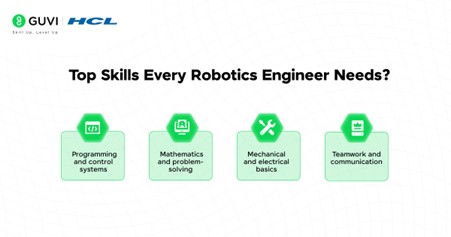
Image Source: guvi
- AI-Powered Maintenance & Optimization: Utilizing machine learning to optimize servo motor performance, predict maintenance needs, and energy efficiency.
- Digital Transformation Skills: Leveraging AI, digital twins, and simulation tools to enhance productivity and reduce operational costs in smart manufacturing.
- Additive Manufacturing (3D Printing): Vital for rapid prototyping and creating lightweight, complex geometries that traditional manufacturing cannot achieve.
- Digital Twin Technology: The ability to create virtual replicas of physical systems for testing and predictive maintenance is becoming a standard “future-ready” skill.
- Collaborative Robotics: Over the past ten years, the worldwide robotics sector has grown rapidly due to developments in automation, machine learning, and artificial intelligence (AI). As businesses look to streamline processes and cut expenses associated with human labor, the demand for skilled mechanical engineers has increased, especially in the automotive and electronics manufacturing sectors.
The “Automation-Plus” Skillset
To bridge the current technical skills gap in the KSA, employers are prioritizing engineers who can cross into software and data domains:
- Programming Proficiency: Knowledge of Python is increasingly required to automate design iterations and handle large datasets from IoT-enabled factory floors.
- AI & Machine Learning Integration: Designing “smart” machines that use AI models to predict equipment failures before they occur.
- Cybersecurity for Industrial Systems: As factories become networked, mechanical engineers are now expected to understand the basics of protecting industrial control systems from digital threats.
- Sector-Specific Applications
Automotive: Skills in welding and assembly robotics for domestic brands like Ceer.
Construction: Expertise in calibration and sensor feedback for autonomous site machinery.
Oil & Gas: Development of robots for hazardous environment inspection and maintenance.
Technology Developments and Cost-Effectiveness in Saudi Arabian Automotive
Rapid technological advancement is making robots more affordable and cost-effective to use in Saudi Arabian automotive applications. Advanced AI, IoT, and vision-enabled robots improve operation efficiency and product quality. Furthermore, decreasing prices of robotic parts and improving ROI in the long run are making manufacturers more inclined towards automating processes.
Issues with Regulatory Frameworks and Workforce Adaption
Even with its quick development, there are still issues with robotics regulatory frameworks and workforce adaption.
Shortage of Skilled Workforce and Technical Expertise:
Automotive robotics deployment and upkeep demand for skilled labor with expertise in systems integration, programming, and automation skills that Saudi Arabia lacks at present. Though moves are being made to boost technical education, the skills gap poses a challenge in operating and solving complex robotics systems effectively. Relying on foreign engineers and technicians drives up the cost of operation and hinders adoption. For sustained growth, investment in technical training courses, partnerships with global robotics companies, and local workforce upskilling are needed to create a strong support infrastructure for industrial automation in the nation.
Increasing Application Area Expansion: One important aspect driving the requirement of skilled mechanical engineers is the rise of robotics’ application areas. The manufacturing of electronics and automobiles has made extensive use of robotics. But recent developments have created a wide range of new uses for operations like planting, weeding, and harvesting in a variety of other industries, including agriculture, which helps to boost productivity and lessen the need for physical labor. In the medical industry, robotics is also being used for patient rehabilitation, diagnostics, and procedures. In addition, it is widely used for operational and customer service duties in the retail and hotel sectors. The adaptability and diversity of contemporary robotic systems that can carry out a variety of activities are what are driving this expansion into these new fields.
Performing Challenging Jobs: Engineering Skills are needed, which have improved robots’ perception and enabled them to interact with their environment more successfully and do challenging jobs more precisely. Additionally, the industry is expanding as a result of new developments in electronic component miniaturization, which are creating robotic systems that are more compact, effective, and economical. These technical advancements enhance the usefulness of robots and increase their accessibility across a wider number of industries, which requires efficient mechanical engineers with designing and manufacturing skills.
Complexity in Human-Robot Interaction: One of the biggest technical challenges is creating robots that can interact with people in a safe and efficient manner while also adapting to changing situations. Robots must process and react to a wide range of stimuli in real-time because human contexts are complicated and ever-changing, unlike predictable industrial settings.
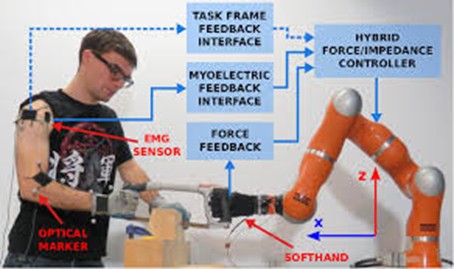
Image Source: researchgate
Sophisticated sensors, cutting-edge AI, and machine learning algorithms are required to ensure that robots can work safely alongside people without injuring them or creating accidents. Additionally, for human-machine communication to be intuitive, robots must be able to comprehend and respond to human actions, emotions, and gestures. Achieving smooth and dependable human-robot interaction that functions in a variety of unstructured settings is still a significant challenge in robotics engineering, despite advancements.
Saudi Arabia Automotive Robotics Controller Policies
Automotive robots are governed by robotics controllers that ensure their motion, precision, and coordination. With increasingly advanced automotive manufacturing plants.
There is a developing demand for multi-axis and programmable controllers. Such systems support real-time monitoring, customization, and accuracy in painting, welding, and assembly processes. Market expansion is driven by the requirement for high-performance and integrated control systems for improved automation productivity and safety. Top international competitors are launching smart controllers that are AI and IoT compatible, consistent with Saudi Arabia’s drive toward Industry 4.0 and smart manufacturing initiatives.
Summary
Numerous industries have embraced cutting-edge equipment and technological solutions more and more in recent years. Companies around the world deal with growing labor expenses, and a shortage of skilled labor are the main causes of these rising labor costs. As a result, more businesses are choosing automated solutions since they are more cost-effective. Industres required essential mechanical engineering skills for enhancing functionality, controllability, and safety in industrial settings, is greatly boosted by this shift.
Saudi Arabia’s Vision 2030 is driving a massive industrial pivot, with the robotics market projected to reach approximately $572.8 million by 2030 at an annual growth rate of 17.7%. This boom is centered in emerging smart cities like NEOM and industrial hubs in Riyadh and Dammam.
Robotics not only lowers the cost of operations in the long run but also guarantees higher throughput and reduced defect rates. As the Saudi automotive sector develops, the need for skilled and intelligent Mechanical Engineer will grow even further, thus making robotics a key part of industrial competitiveness.
Continue Learning With KEN
We believe in the importance of keeping abreast of the latest advancements in health and safety protocols. Regularly updating our students’ knowledge to help them stay informed about new best practices, and regulations, enabling to deliver the most relevant updates.
Join us and unlock a world of online courses in Mechanical Engineering, Occupational Health and Safety, Fire Safety, and Environment and Sustainability. Propel your career to new heights.
Propel your career to new heights.
Connect now and take the next step toward professional excellence!
+91 7569034271
Let’s connect together on: Facebook, YouTube, LinkedIn, and Instagram.