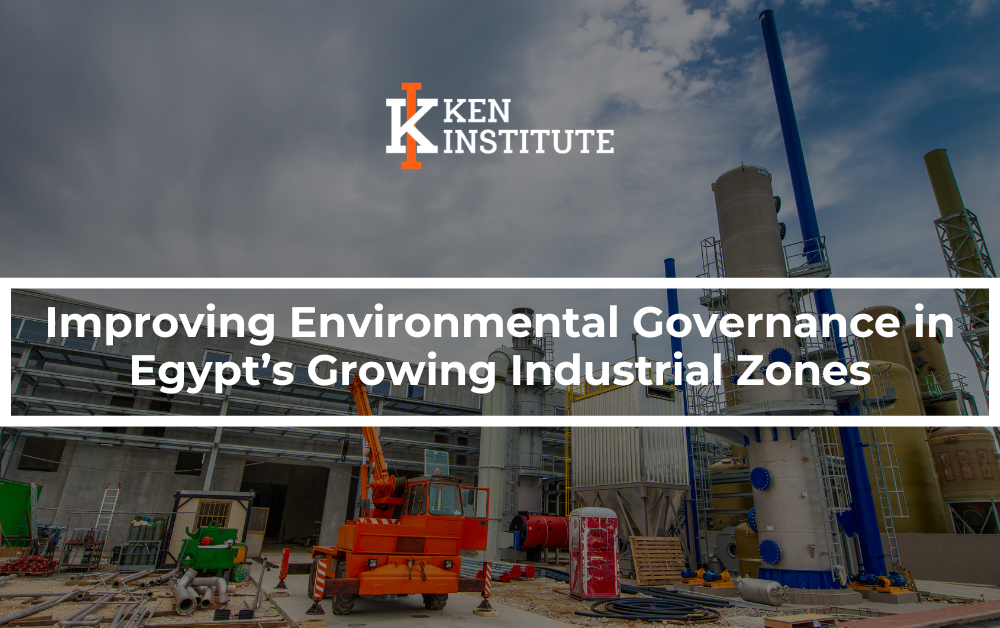
Improving Environmental Governance is crucial for sustainable growth in Egypt. Accelerated expansion of Egypt’s industrial sector, with over 127 economic zones established as of 2022 and persisting developments adding thousands of factories and jobs. To pace with this rapid industrial growth, Egypt has to face significant environmental pressures from pollution, water stress, and waste. While key Environmental Governance initiatives and strategies can address these challenges effectively.
Key Challenges
Rapid industrialization- in zones like 10th of Ramadan, 6th of October, and Borg El Arab has led to air pollution, inefficient water use, and industrial waste issues, compounded by high population growth and climate vulnerability.
Water scarcity – Egypt is one of the world’s most water-stressed nations, with agriculture and industry consuming vast resources inefficiently.
Limited coordination – among regulatory bodies, high costs of clean technologies, and insufficient public participation further hinder progress.
Challenges of Pollution in Egypt’s Industrial Zones
Egypt’s industrial zones, wrestle with severe pollution from rapid expansion, without adequate waste treatment.
Water Pollution Challenges
Industrial discharges elevate COD (13.1–59.6 mg/L), BOD (7.67–36.5 mg/L), total nitrogen (1.13–3.35 mg/L), and phenols in the Nile near Aswan and Cairo zones, creating hotspots of poor water quality.
Air Pollution Challenges
Factories contribute 17% of Cairo’s PM2.5 via iron/steel, cement, and power emissions, worsened by desert dust and waste burning. Annual PM2.5 averages 13.6 times WHO limits, causing 18,000 premature deaths yearly in Cairo alone.
Waste and Enforcement Challenges
Limited hazardous waste facilities and poor recycling lead to open dumping and burning. Enforcement gaps from coordination lacks, high clean-tech costs, and untrained staff hinder compliance; many plants evade EIAs. Economic pressures like currency shortages delay imported pollution control.
Improvement Strategies
Egypt partners with United Nations Industrial Development Organization (UNIDO) and Switzerland under the Global Eco-Industrial Parks Programme (GEIPP) to develop eco-friendly zones like Polaris Parks, focusing on waste reduction, emissions cuts, and resource efficiency, including mainstreaming climate action and enhancing economic instruments for water management. World Bank analyses prioritize circular economy approaches for industrial pollution control and stronger environmental governance frameworks.
Alignment with Vision 2030 For Environmental Governance
Egypt implements following strategies align with Egypt’s Vision 2030 for Environmental Governance
- Adopt eco-industrial park models to promote collaboration among businesses for shared resource use and emissions reduction.
- Integrate economic incentives like green financing and pollution fees to encourage cleaner production and waste recycling.
- Boost regulatory enforcement through better data, public involvement, and capacity building in governorates.
- Accelerate clean energy adoption, such as solar in industrial areas, and improve wastewater reuse per the National Water Resources Plan.
(OECD) Green Growth Policy
The OECD (Organisation for Economic Co-operation and Development) Green Growth Policy Review of Egypt 2024 provides recommendations to enhance environmental performance, with a strong focus on industrial sectors through climate action, resource efficiency, and green growth strategies. Specific steps relevant to industries emphasize mainstreaming climate policies and leveraging private investment.
Climate Mitigation Steps
Pursue ambitious emissions reductions in energy industries (28% of emissions) and manufacturing/construction (15%), building on sector-specific 2030 targets like 12% cuts in industrial processes.
Strengthen monitoring and regular GHG emissions reporting to evaluate mitigation impacts in heavy industries.
Accelerate clean energy transitions by scaling renewables to 42% of electricity by 2030 via green bonds, concessional loans, and private power purchase agreements for low-emission industrial projects.
Resource Management Steps
Use economic instruments like pollution fees and water pricing to address scarcity and improve quality in water-stressed industrial zones.
Promote circular economy models, including waste recycling upgrades and infrastructure for SMEs in industrial recycling.
Enhance adaptation in industrial strategies with dedicated budgets for water management and resilient infrastructure.
Policy and Enforcement Steps
Strengthen institutional frameworks for environmental policy enforcement, improving impact assessments and permitting without compromising quality.
Boost public participation and data transparency to support industrial decision-making. Prioritize green fiscal reforms, such as removing inefficient subsidies, to incentivize cleaner industrial practices.
Eco-Industrial Parks Like GEIPP
Implementing eco-industrial parks (EIPs) like those under the Global Eco-Industrial Parks Programme (GEIPP) in Egypt involves transforming existing industrial zones into resource-efficient, collaborative ecosystems that minimize environmental impact while boosting competitiveness.
Preparation Steps
Raise awareness among stakeholders in private and public sectors about EIP benefits, such as reduced emissions and resource optimization.
Scope and prioritize activities by assessing baseline compliance with national regulations, then identify synergies like waste reuse.
Secure partnerships with bodies like Egypt’s Ministry of Trade and Industry, Industrial Development Authority, and Suez Canal Economic Zone.
Policy and Management Steps
Integrate EIP concepts into national policies for industrial development and governance.
Establish sustainable park management structures for shared infrastructure, investment attraction, and worker conditions.
Build capacities through training on technical and non-technical skills for tenants and operators.
Technical Implementation Steps
Promote Resource Efficient and Cleaner Production (RECP) at company level, including low-carbon tech, renewables, and energy efficiency.
Foster industrial symbiosis: enable exchanges of materials, energy, water, by-products, and services among tenants.
Install sustainable infrastructure like water recycling, renewable energy, and waste management systems.
Monitoring and Expansion Steps
Track progress via performance monitoring and benchmarking against objectives.
Engage local communities for symbiosis, enhancing social responsibility and regional development.
Scale successes nationally, as in GEIPP’s goal to influence broader industrial policies by 2024.
Role of Ministry of Environment in industrial pollution control
Egypt’s Ministry of Environment, through its executive arm the Egyptian Environmental Affairs Agency (EEAA), leads industrial pollution control under Environmental Law..
Regulatory Enforcement
classifying issues -Environmental Impact Assessments (EIAs) and licenses for industrial projects, by pollution risk and mandating mitigation plans.
Oversees the Egyptian Pollution Abatement Project (EPAP), providing loans for cleaner technologies and compliance upgrades in sectors like chemicals and textiles.
Monitoring Systems
Operates a national continuous monitoring network with sensors at polluting facilities to track wastewater discharges in real-time, linked to a central database for violation detection.
Coordinates air quality monitoring and rapid response, including in Greater Cairo initiatives with World Bank support.
Policy and Incentives
Establishes economic incentives via the Environmental Fund for pollution reduction tech and supports eco-industrial parks under GEIPP.
Promotes cleaner production through awareness, training, and symbiosis in industrial zones.
Collaborates with governorates and ministries for hazardous waste management and oil spill contingencies.
Barriers that Slaking Down Improvement Environmental Governance
Despite support from the Egypt National Cleaner Production Centre, a number of barriers slow progress in SMEs and heavy industries like textiles, chemicals, and construction.
Economic Barriers
High initial investment costs, especially amid Egypt’s economic pressures like inflation and currency shortages. Limited access to green financing or incentives. Market focus on low price and speed over sustainability reduces demand for CP products.
Technical Barriers
Lack of local expertise and skills in RECP assessments, energy audits, and solar thermal applications hinders implementation. Limited availability of affordable, adapted clean technologies, plus inadequate infrastructure for waste valorization and chemicals management. Dependence on imported equipment raises costs and supply chain risks.
Regulatory and Awareness Barriers
Insufficient financial incentives and weak enforcement of CP policies fail to motivate industries. Low awareness among firms about CP benefits, coupled with regulatory gaps in standards for efficient motors or solar systems. ENCPC addresses these via training but scales slowly due to fragmented support.
Recent Government Policies to Reduce Industrial Emissions
Recent Egyptian government policies target industrial emissions through updated climate strategies, monitoring enhancements, incentives, and aligning with the Strategy 2050 and revised NDCs. Key measures emphasize real-time enforcement and green transitions.
Emissions Monitoring and Enforcement
Electronically linked 96 major industrial facilities to the national emissions monitoring system under Environmental Law amendments, enabling real-time tracking and penalties for exceedances.
Expanded the National Air Quality Monitoring Network to 121 stations, targeting 50% PM10 reduction by 2030 from 2015 baseline (157 µg/m³ to 102 µg/m³).
Sector-Specific Targets
Updated NDCs commit to 37% electricity sector cuts, 65% oil/gas reductions, and prioritizing cement, fertilizer, and iron/steel for efficiency upgrades. National Low-Carbon Hydrogen Strategy (2024) aims for 5-8% global green H2 market by 2040, supporting industrial decarbonization.
Incentives and Infrastructure
Regulated voluntary carbon market via Financial Regulatory Authority decrees (2024–2025) for GHG credit trading and verification. Boosted energy efficiency economy-wide, including industrial renewables and waste-to-energy under Waste Management Law backed reforms promote green financing for cleaner tech in industries.
Summary
Egypt faces significant technical and economic hurdles in adopting cleaner production (CP), with the aim of improving Environmental Goverance to minimize waste and emissions through efficient processes. Improving environmental governance in Egypt’s growing industrial zones requires balancing rapid industrial expansion with stronger environmental regulation, enforcement, and sustainability planning. Egypt has expanded industrial and investment zones across governorates to attract investment and create jobs. However, governance challenges remain significant as industrial activity increases.
Join Ken Institute now to advance your career with Higher Certification in Environmental & Sustainability !
Internationally recognized courses and training programs designed to empower individuals and organizations. Our commitment is “academic excellence, quality standards, and robust training processes”.
Connect now and take the next step toward professional excellence!
+91 7569034271
Let’s connect together on: Facebook, YouTube, LinkedIn, and Instagram.